
If you’re searching for an OCD therapist, you’re likely exhausted. Exhausted by the rituals you can’t seem to stop, the intrusive thoughts that feel too dark to say out loud, the hours lost to checking, washing, counting, confessing, or mentally reviewing. Maybe you’ve tried talk therapy already and walked away feeling like the therapist didn’t quite get it — or worse, made the OCD louder by reassuring you in ways that only fed the cycle.
I’m Sara Makin, founder and Chief Medical Officer of Makin Wellness. As a clinician who has spent more than a decade specializing in evidence-based anxiety and OCD care, I want to tell you what most general therapists won’t: OCD requires a specific kind of treatment, delivered by a clinician with specific training. The right OCD therapist can change the trajectory of your life. The wrong one can keep you stuck for years.
This guide will walk you through what an OCD therapist actually does, how to know if you need therapy for OCD, and what to look for when choosing a specialist.
What OCD Is — and What It Isn’t
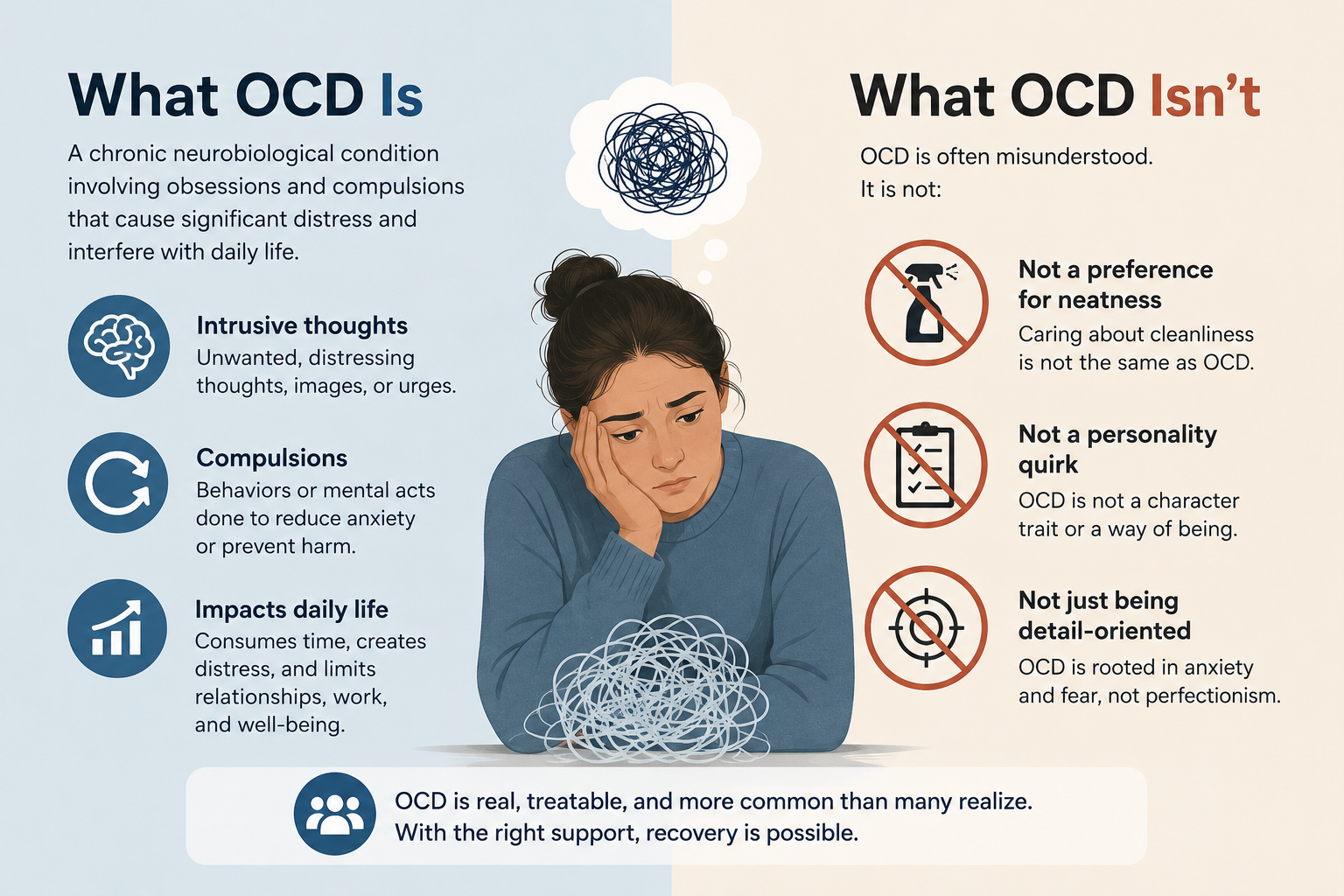
Obsessive-compulsive disorder is a chronic neurobiological condition characterized by obsessions (intrusive, unwanted thoughts, images, or urges) and compulsions (behaviors or mental acts performed to neutralize the distress those thoughts create). It is not a personality quirk, a preference for neatness, or a synonym for being detail-oriented. The cultural shorthand “I’m so OCD” has done real damage — it has convinced people whose lives are genuinely being eroded by the condition that they’re overreacting, and it has obscured how serious OCD can be when left untreated.
Roughly 1 in 40 adults in the United States meets criteria for OCD in their lifetime. The average person waits 11 to 17 years between symptom onset and accurate treatment. That gap is not because OCD is rare or treatment doesn’t exist. It’s because most therapists are not trained in the methodology that actually works.
Do I Need Therapy for OCD?
This is the question I hear most often, usually whispered, usually preceded by “I know this is going to sound crazy, but…”
It doesn’t sound crazy. And the honest answer is: if OCD is taking up meaningful time, energy, or emotional bandwidth in your life, yes — you need therapy. You don’t have to wait until you’re in crisis.
Here are the signals I look for in a clinical assessment:
You’re spending more than an hour a day on obsessions or compulsions. This is the diagnostic threshold, but for many people the real number is closer to four, five, or eight hours when you add up the time lost to mental rituals, avoidance, and recovery from spikes.
You’re avoiding people, places, foods, words, numbers, or situations because of intrusive thoughts. Avoidance is a compulsion in disguise. It looks like a lifestyle choice but it’s the disorder narrowing your world.
The thoughts disturb you in a way that feels foreign to who you are. OCD specializes in attaching itself to the things you care about most — your children, your relationship, your faith, your sexuality, your safety. The content of an intrusive thought is rarely the issue. The brain’s inability to dismiss it is.
You’ve tried to stop on your own and it’s not working. Willpower is not the missing ingredient. OCD doesn’t respond to logic, reassurance, or “just don’t think about it.” It responds to a specific clinical protocol.
You’re exhausted. Untreated OCD is a full-time job your brain has assigned you without asking. Therapy is how you quit.
If any of those resonate, you don’t need to wonder whether your case is “bad enough” to deserve help. It is.
Ready to talk to a specialist? Schedule a free 15-minute consultation with a Makin Wellness OCD therapist — no commitment, just a conversation about whether we’re the right fit.
The Role of an OCD Therapist
A good OCD therapist does five things that a general talk therapist typically does not.
- They make a precise diagnosis. OCD is frequently misdiagnosed as generalized anxiety, depression, ADHD, or a personality disorder. It also commonly co-occurs with these conditions. A trained OCD therapist uses validated assessment tools — most often the Yale-Brown Obsessive Compulsive Scale (Y-BOCS) — to map your specific subtype, severity, and symptom presentation before treatment begins. Treatment fails when the diagnosis is fuzzy.
- They use Exposure and Response Prevention as the core intervention. ERP is the gold-standard, research-validated treatment for OCD, endorsed by the American Psychological Association, the International OCD Foundation, and the NICE guidelines in the UK. ERP is not exposure therapy in the casual sense. It is a structured, gradual process in which you deliberately confront the triggers that fuel obsessions while resisting the compulsion that normally follows. Over time, your brain learns that the threat isn’t real and that the discomfort, however intense, is survivable and temporary. ERP is uncomfortable. It is also remarkably effective: most people who complete a full course see clinically significant improvement, and many achieve remission.
- They refuse to provide reassurance. This is one of the clearest markers of a trained OCD therapist. Reassurance — “No, you’re not a bad person. No, you didn’t really do that.” — feels kind, but for someone with OCD it functions as a compulsion. Every time you receive reassurance, the disorder learns that the only way to tolerate uncertainty is to outsource it. A specialist will gently but firmly decline to play that role and will teach you to sit with not-knowing instead.
- They integrate adjunctive approaches when appropriate. ERP is the engine, but a skilled OCD therapist also draws from cognitive behavioral therapy to address distorted beliefs, acceptance and commitment therapy (ACT) to build psychological flexibility, and inference-based CBT for certain OCD subtypes. They coordinate with a prescribing provider when SSRIs or other medications are part of the plan.
- They treat the whole person. OCD rarely arrives alone. It frequently coexists with depression, generalized anxiety, ADHD, trauma history, and disordered eating. A qualified OCD therapist knows how to sequence treatment, identify what’s driving what, and adapt the protocol when a comorbidity needs attention first. They also work with families and partners, who are often pulled into accommodations that unintentionally maintain the disorder.
What to Look For When Choosing an OCD Therapist
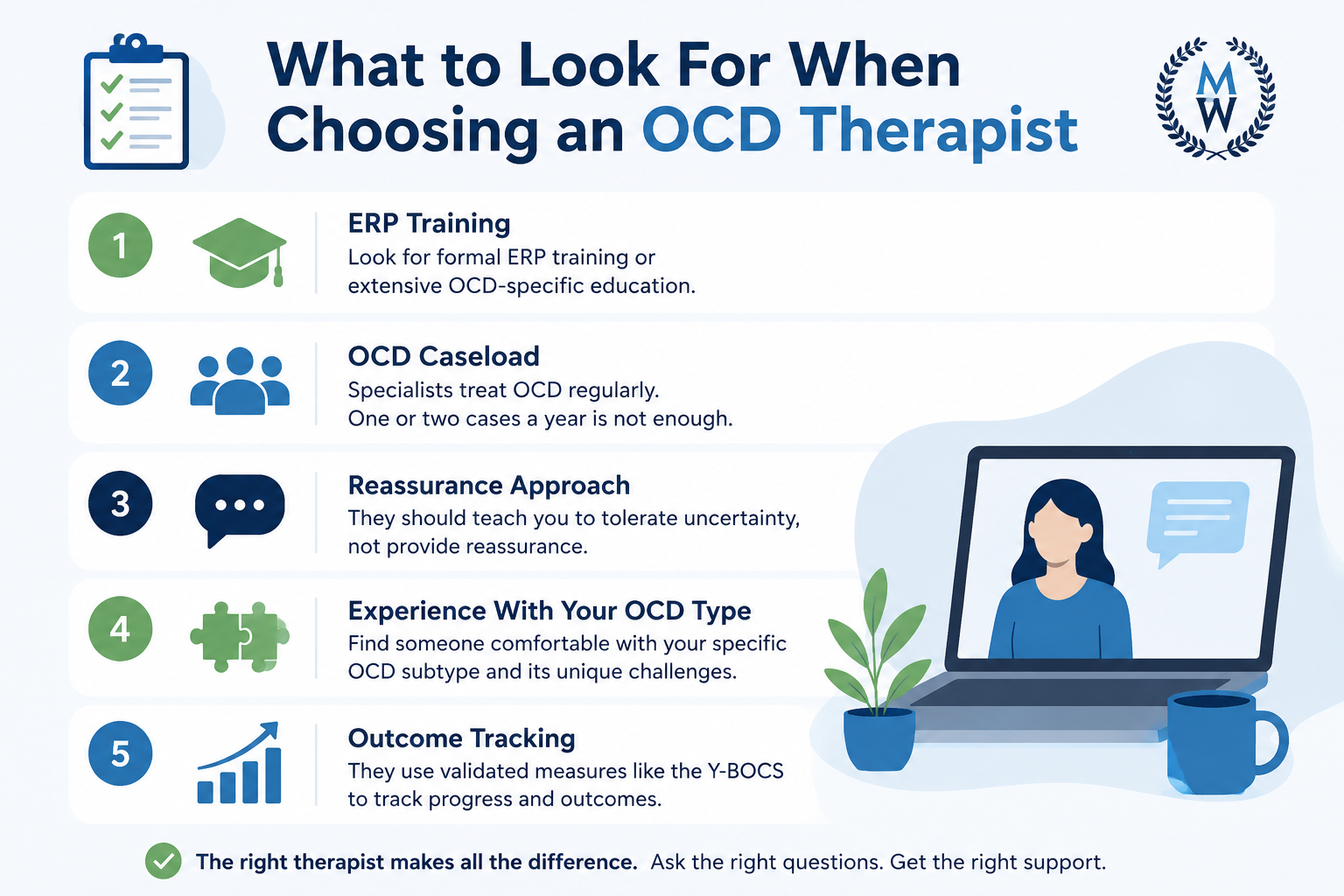
Not every clinician who lists “anxiety” or “OCD” on their profile is qualified to treat it. As a CMO, here is what I tell people to ask:
Ask whether they have completed formal ERP training — through the International OCD Foundation’s Behavior Therapy Training Institute (BTTI), a similar program, or extensive supervised post-graduate work in OCD specifically. General CBT training is not the same as ERP training.
Ask how many active OCD cases they currently carry. Specialists usually have a meaningful portion of their caseload dedicated to OCD. A clinician who treats one or two cases a year is not a specialist.
Ask how they handle reassurance-seeking. The right answer is something like, “I don’t provide reassurance. I teach you to tolerate uncertainty instead.”
Ask whether they’re comfortable with your specific OCD subtype. Harm OCD, contamination OCD, scrupulosity (religious or moral OCD), relationship OCD, sexual orientation OCD, postpartum OCD, and “Pure O” all share the same underlying mechanism but require an experienced clinician who won’t be thrown by the content of your intrusive thoughts.
Ask about outcome tracking. Does the practice use the Y-BOCS or another validated measure at intake and throughout treatment? A specialist welcomes accountability.
What to Expect at Makin Wellness
At Makin Wellness, every client who comes in for OCD care is matched with a therapist trained in evidence-based protocols, including ERP. Treatment typically begins with a thorough diagnostic assessment, followed by 12 to 20 sessions of structured ERP, with progress measured at regular intervals using validated tools. Sessions are available virtually across our licensed states, which removes the geographic barrier that keeps so many people from accessing specialist care.
We accept most major insurance plans, and our intake team can verify your benefits before your first session so there are no surprises. For clients whose OCD requires medication coordination, our clinical team partners closely with prescribers to keep the treatment plan integrated.
If you’ve tried therapy before and felt like it didn’t work, that is not evidence that you can’t get better. It is far more often evidence that the treatment wasn’t matched to the disorder.
Take the first step. Book a free 15-minute consultation with a Makin Wellness OCD specialist today. We’ll listen, answer your questions, and help you understand what evidence-based OCD treatment could look like for you.
Frequently Asked Questions
How long does OCD therapy take?
Most clients see meaningful improvement within 12 to 20 weekly sessions of ERP, though severity, subtype, and comorbidities influence the timeline. Intensive outpatient and accelerated formats are available when symptoms warrant faster care.
Is OCD therapy covered by insurance?
In most cases, yes. Makin Wellness is in-network with most major commercial insurance plans, and our team will verify your specific benefits before treatment begins.
Can OCD be cured?
OCD is a chronic condition, but it is highly treatable. The clinical goal is remission — meaning symptoms become so manageable that they no longer interfere with your daily life. Many clients reach a point where OCD no longer drives their decisions.
Do I need medication for OCD?
Not always. ERP alone is effective for many people. For moderate-to-severe OCD, or when ERP plateaus, SSRIs are an evidence-based addition. Your therapist will help you think through whether a medication consult makes sense.
What if my intrusive thoughts are really disturbing or taboo?
Tell us anyway. Harm OCD, sexual OCD, and scrupulosity often involve thoughts that feel unspeakable. A trained OCD therapist has heard it before and will not be shocked, will not report you, and will not assume the thoughts mean anything about who you are. Disclosure is part of treatment.
Can OCD therapy be done virtually?
Yes. ERP has strong outcome data when delivered via telehealth, and most Makin Wellness clients receive care this way. The only adjustment is that some in-vivo exposures (such as touching contaminated objects in a specific environment) are coached rather than supervised in person.