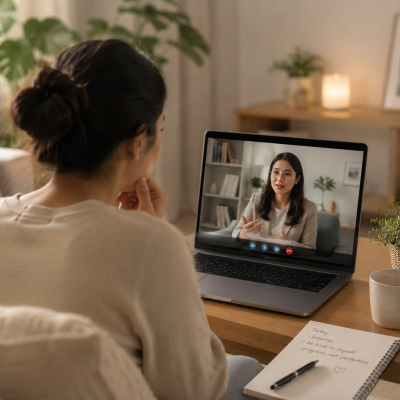
If you’ve been asking yourself, “Can a therapist help with anxiety?” you’re not alone. Just like many people, you could be wondering whether online therapy can actually make a difference, especially if you’ve been feeling anxious for a long time.
The short answer is yes. Online therapy is one of the most effective treatments for anxiety, and you can experience significant improvement with the right support.
As a therapist, I’ve worked with countless clients who initially believed their anxiety was simply part of their personality. They described themselves as “just a worrier” or “someone who overthinks everything.” Over time, many discovered that anxiety was not who they were—it was something they could learn to manage.
Can a Therapist Help With Anxiety?

Yes. A therapist can help you understand your anxiety, identify the patterns that may be making it worse, and teach you healthier ways to respond to anxious thoughts and feelings.
One of the biggest misconceptions I hear is that online therapy is just talking about your problems. While those conversations matter, effective anxiety therapy is much more practical than many people expect. My goal isn’t simply to help clients understand why they feel anxious. It’s to help them build the skills and confidence to handle anxiety differently when it shows up.
Online therapy looks different for everyone because anxiety affects everyone differently. Some people come to therapy because they’re exhausted by constant worry or overthinking. Others want to stop panic attacks from controlling their lives, feel more emotionally balanced, or learn healthier ways to cope with stress. As online therapy progresses, you can find you become more confident, feel less controlled by fear, improve your relationships, and become more present in your everyday life.
One of the most important things I want you to understand is this: Anxiety isn’t always a sign that something is wrong. More often, it’s a sign that your mind is working overtime to protect you from uncertainty, discomfort, or perceived danger.
The goal of online therapy isn’t to eliminate every anxious thought. That’s neither realistic nor necessary. The goal is to help you respond to anxiety in a way that allows you to live your life more fully, without letting fear make every decision.
“One of the biggest breakthroughs in therapy isn’t when anxiety disappears. It’s when you realize you can keep living your life even when anxiety shows up.”
What Does Anxiety Actually Feel Like?
One of the most common things I hear from new clients is, “I don’t even know if this is anxiety.” They expected anxiety to feel like nervousness before a big presentation. Instead, they find themselves replaying conversations, lying awake at night, or always waiting for something to go wrong.
The truth is, anxiety doesn’t look the same for everyone. You can struggle with constant worry and racing thoughts. Others notice muscle tension, trouble sleeping, difficulty concentrating, or feeling on edge throughout the day. I’ve also worked with clients whose anxiety showed up as irritability, panic attacks, avoiding situations that felt uncomfortable, or constantly seeking reassurance because uncertainty felt unbearable.
One thing I’ve noticed over the years is that many people don’t realize how much anxiety has been affecting them until they finally experience a little relief. They’ve spent so long living in a state of constant alertness that it starts to feel normal. When living in survival mode becomes your normal, calm can actually feel unfamiliar.
Why Does Anxiety Happen?
Anxiety isn’t a flaw in your brain. It’s your brain trying a little too hard to protect you.
One of the first things I explain to my clients is that anxiety isn’t trying to hurt them. It’s trying to keep them safe. The issue is that it often mistakes uncertainty for danger. Instead of saying, “Let’s wait and see,” anxiety says, “Let’s prepare for the worst, just in case.” That’s why anxiety can feel so convincing, even when there’s no real evidence that something bad is about to happen.
The reasons behind anxiety aren’t always obvious. In my experience, it’s usually a combination of several factors rather than one single cause. Anxiety can be influenced by stressful life events, personality traits, family history, trauma, chronic stress, major life transitions, health concerns, and relationship challenges.
Sometimes there is an obvious trigger. Other times, you can experience anxiety even when nothing appears to be wrong. This often leads you to ask, “Why am I anxious when my life is actually going okay?”
I’ve worked with many clients who were frustrated because they couldn’t point to a clear reason for feeling anxious. Often, anxiety isn’t just about what’s happening today. It’s also shaped by past experiences, learned patterns, and the way your brain responds to uncertainty. Understanding where your anxiety comes from is often the first step toward learning how to manage it.
How Does Online Therapy Help Anxiety?
Online therapy helps by addressing both the symptoms of anxiety and the underlying patterns that keep it going. Every person’s experience with anxiety is different, so treatment isn’t one-size-fits-all. Together, you and your therapist will focus on the areas that matter most to your life and your goals.
One of the first things we do is identify what tends to trigger your anxiety. While you may know you feel anxious, you can’t be sure why. Sometimes the trigger is obvious, like a stressful situation or major life change. Other times, it’s more subtle. Certain thought patterns, habits, or even situations you’ve started avoiding without realizing it can all contribute to anxiety.
We’ll also look at the way anxiety influences your thinking. Anxiety has a way of convincing you that the worst-case scenario is the most likely one or that uncertainty is something to fear. In therapy, you’ll learn how to recognize those patterns, question them with curiosity instead of fear, and replace them with more balanced, realistic ways of thinking.
Another important part of online therapy is learning practical skills you can use in everyday life. Depending on your needs, that might include grounding techniques when anxiety feels overwhelming, mindfulness exercises to stay present, relaxation strategies to calm your body, or emotional regulation skills that help you respond instead of react. The goal isn’t to memorize coping techniques. It’s to build a toolbox you can rely on when anxiety shows up.
One of the biggest traps I see is avoidance. It makes sense because avoiding something that makes you anxious usually brings immediate relief. The problem is that your brain interprets that relief as proof you escaped something dangerous. The next time you face a similar situation, your anxiety often comes back even stronger.
That’s why online therapy isn’t about forcing you into uncomfortable situations before you’re ready. It’s about helping you gradually face your fears in a way that feels safe and manageable. Over time, your brain begins to learn something new: you can handle uncertainty, discomfort, and fear without letting them control your life. That’s where confidence starts to grow.
What Type of Therapist Is Best for Anxiety?
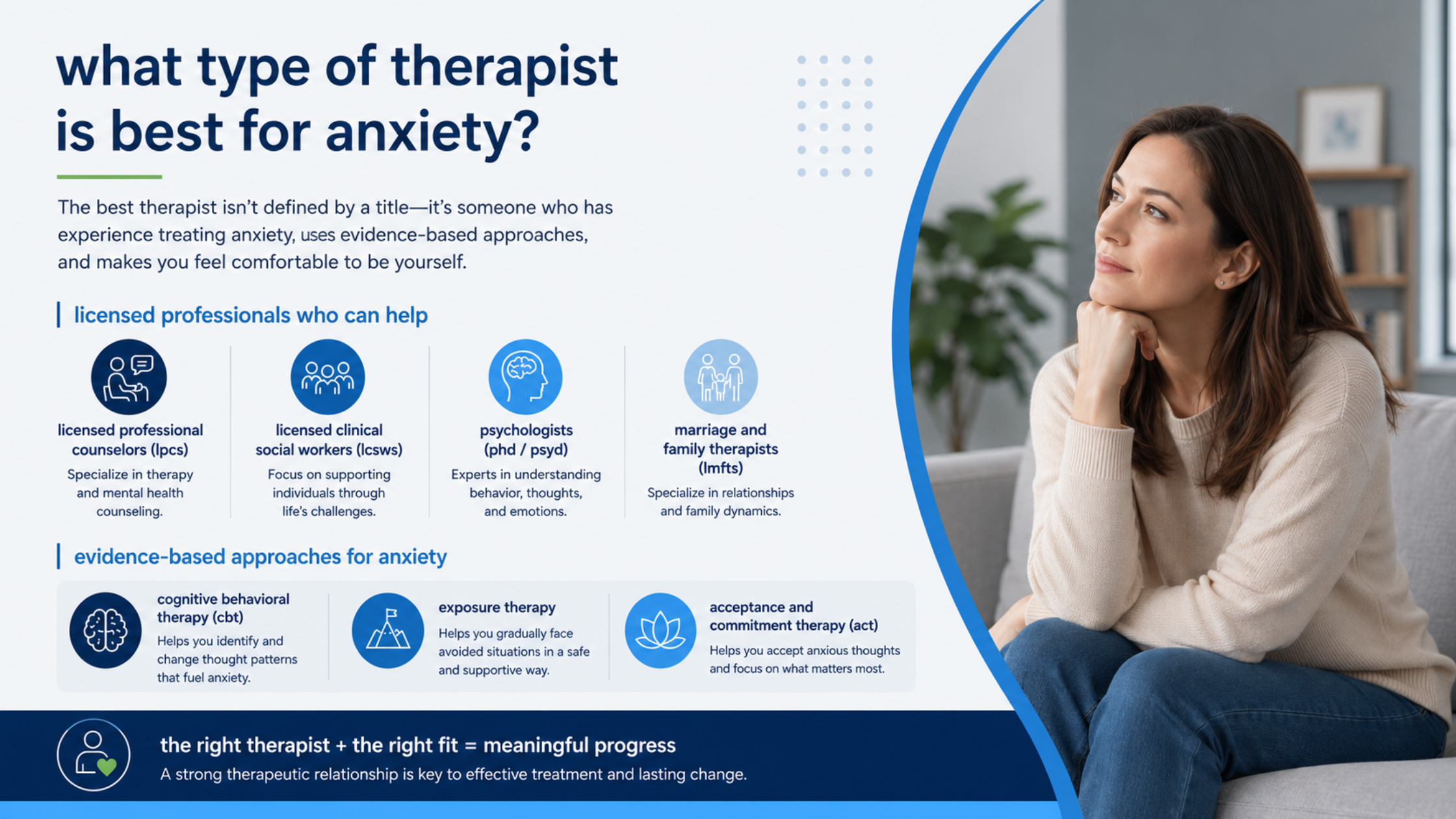
When people ask, “What type of therapist is best for anxiety?” they’re usually hoping there’s one clear answer. The truth is, the best therapist isn’t defined by a single license or title. It’s someone who has experience treating anxiety, uses evidence-based approaches, and helps you feel comfortable enough to be honest about what you’re going through.
Several types of licensed mental health professionals can effectively treat anxiety, including Licensed Professional Counselors (LPCs), Licensed Clinical Social Workers (LCSWs), Psychologists, and Marriage and Family Therapists (LMFTs). While their training and areas of expertise may differ, many are highly qualified to help you manage anxiety.
Rather than focusing only on a therapist’s credentials, I encourage you to ask questions about their experience. Do they regularly work with clients who have anxiety? What treatment approaches do they use? Finding someone who understands anxiety and has experience treating it is often more important than the letters after their name.
One of the most effective approaches for anxiety is Cognitive Behavioral Therapy (CBT). CBT helps you recognize the thought patterns that fuel anxiety and teaches you how to respond to them in healthier, more balanced ways. It’s also one of the most researched treatments for anxiety disorders.
Depending on your needs, your therapist may also recommend Exposure Therapy, which helps you gradually face situations you’ve been avoiding in a safe and supportive way. Although it can sound intimidating at first, exposure therapy is carefully paced and has been shown to be highly effective for conditions like phobias, panic disorder, social anxiety, and obsessive-compulsive disorder.
Another approach I often use is Acceptance and Commitment Therapy (ACT). Instead of trying to eliminate anxious thoughts completely, ACT teaches you how to stop struggling with them so they have less influence over your decisions. Many therapists also incorporate mindfulness-based techniques, which can help you stay grounded in the present instead of getting caught up in endless “what if” scenarios.
At the end of the day, research and experience both point to the same conclusion: the relationship you build with your therapist matters. If you feel understood, respected, and supported, you’re much more likely to stay engaged in therapy and make meaningful progress. That’s why I always encourage people to look for a therapist who specializes in anxiety and feels like a good fit for them—not just someone with the right credentials.
How Do I Know If I Should See a Therapist for Anxiety?
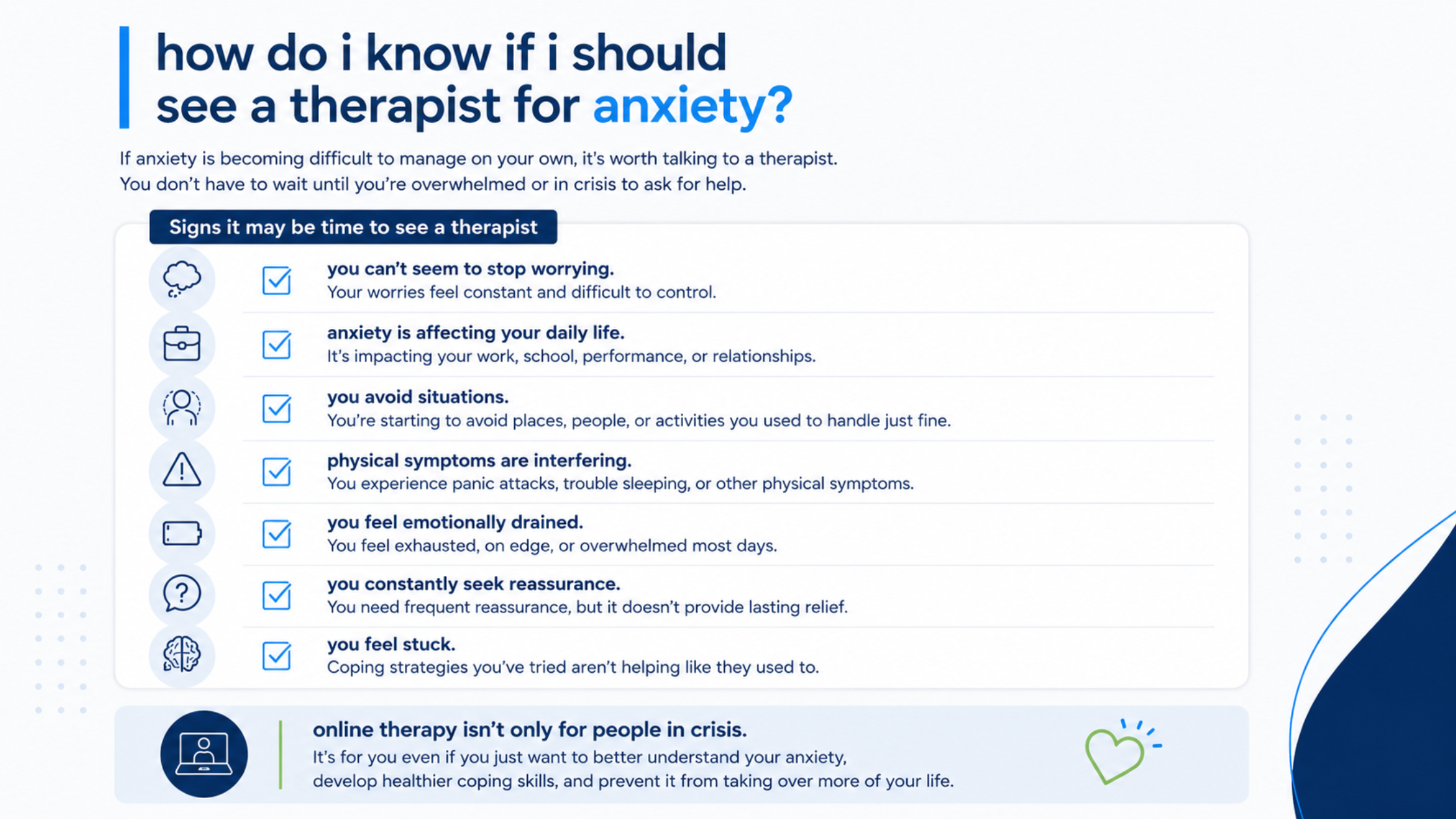
One of the most common questions I hear is, “Is my anxiety bad enough for therapy?” My answer is almost always the same: you don’t have to wait until you’re overwhelmed or in crisis to ask for help.
If anxiety is becoming difficult to manage on your own, it’s worth talking to a therapist. That might mean you can’t seem to stop worrying, your anxiety is affecting your work, school, or relationships, or you’ve started avoiding situations that once felt manageable. Anxiety can show up as panic attacks or trouble sleeping. You can also feel emotionally drained, constantly seek reassurance, or feel stuck even after trying different coping strategies on your own.
One thing I’ve learned from working with clients is that people often wait much longer than they need to before reaching out. They tell themselves, “Other people have it worse,” or “I should be able to handle this myself.” Online therapy isn’t only for people in crisis. It’s for you even if you just want to better understand your anxiety, develop healthier coping skills, and prevent it from taking over more of your life.
You don’t have to wait until anxiety controls your life before asking for support. In fact, seeking help early can make it easier to build effective coping strategies before anxiety becomes even more disruptive.