
OCD, at its core, involves intrusive thoughts (obsessions) and repetitive behaviors (compulsions). While people often refer to four main types of OCD, there are actually multiple subtypes, such as contamination, checking, and intrusive thoughts. The most effective treatment is Exposure and Response Prevention (ERP).
Obsessive-Compulsive Disorder (OCD) is often misunderstood.
You may have heard people chalking it up to an awkward germophobia or liking things neat.
It’s much more than that, and sometimes it can look nothing like that.
If you find yourself overwhelmed by unwanted thoughts and compelled to do things repeatedly to feel safe or “right,” you may be living with OCD.
What Is OCD?
Obsessive-Compulsive Disorder (OCD) is a mental health condition involving unwanted, intrusive thoughts (obsessions) and repetitive behaviors or mental acts (compulsions) performed to reduce anxiety.
What are obsessions and compulsions in OCD?
What Are Obsessions?
Obsessions are persistent, unwanted thoughts, images, or urges that cause distress or anxiety. These thoughts are intrusive and often feel challenging to control or ignore.
Examples of obsessions:
- “What if I harmed someone without realizing it?”
- “What if I left the stove on and caused a fire?”
- “Is this thought a sin?”
What Are Compulsions?
Compulsions are repetitive behaviors or mental rituals performed to reduce the anxiety caused by obsessions. While they may provide temporary relief, they reinforce the OCD cycle over time.
Examples of compulsions:
- checking locks, appliances, or emails repeatedly
- washing hands or cleaning excessively
- mentally repeating phrases or prayers
Together, obsessions and compulsions create the OCD Cycle.
The OCD cycle follows a repeating pattern: Obsession → Anxiety → Compulsion → Temporary Relief → Reinforcement. This cycle keeps OCD going by teaching your brain that compulsions reduce fear.
For instance, you may find yourself continuously feeling uncomfortable (obsession) because you were in a building where you experienced something painful.
This starts to multiply (anxiety), leading to feeling the need to act to soothe the anxiety.
So, you start to wash your hands, as well as anything that was in contact with that space (compulsion).
While you probably know, at that moment, that this will not actually fix the issue, you feel much better (temporary relief).
Later, when you find yourself back in that building, the compulsion feels even more necessary because it seemed to fix the anxiety you were feeling last time (reinforcement).
The OCD Cycle can be extremely frustrating because, the more it repeats itself, the more necessary it feels to you, leading you to feel increasingly trapped and anxious.
If you’re recognizing these patterns in your own life, talking with a therapist trained in OCD can help you break the cycle.
Why Does OCD Happen?
If you’ve ever wondered why your brain seems to get stuck on certain thoughts or fears, you’re not alone.
OCD can feel confusing, especially when you logically know something isn’t dangerous, while still feeling very real.
One thing that’s important to understand is this:
OCD often shows up in people who are thoughtful, aware, and mentally sharp.
The same brain that helps you notice details, think deeply, and care about doing things right can also make you more sensitive to uncertainty and “what if” thinking.
At its core, OCD isn’t about weakness or something being “wrong” with you. It’s about how your brain is trying to protect you, just in an overactive way.
What are the 4 types of OCD?
If you’ve been trying to make sense of what you’re experiencing, it can really help to know that OCD doesn’t look the same for everyone.
People often talk about four main types of OCD because they’re the most common ways OCD tends to show up.
Here are the four types of OCD you’ll hear about most often:
1. Contamination OCD
This type centers around a strong fear of germs, illness, or contamination.
You might feel the urge to wash, clean, or avoid certain places or people to stay safe. It can feel exhausting, especially when the fear doesn’t match the actual risk.
For instance, you may want to avoid a place at which a painful experience occurred. If you have to go there, you may feel dirty, contaminated.
Your friends and family may be perplexed, frustrated, or even amused in reaction, while you are experiencing an exhausting level of overwhelm.
It can create a lot of painful misunderstandings, particularly if the people around you do not take the time to understand your thoughts and feelings.
2. Checking OCD
Checking OCD is driven by doubt and fear of making a mistake or causing harm.
You might find yourself repeatedly checking things like locks, appliances, or messages, even when you already know everything is okay.
You go back into the house after getting in the car four times to make sure that the oven is really turned off. If you do it less than four times, you may feel insecure and anxious.
That “just in case” feeling can be really hard to shake.
3. Symmetry and Order OCD
This type is about things needing to feel “just right.”
It’s not just liking things neat, it’s a deep sense of discomfort when things feel off, uneven, or out of place.
You may feel paralyzed to continue on with your day until you change your jeans that you thrifted last week because you realized that oddly enough, the pant legs are uneven.
You might spend a lot of time arranging, aligning, or repeating actions until the feeling settles.
4. Intrusive Thoughts OCD
This type involves unwanted thoughts that can feel scary, confusing, or completely out of character.
These thoughts might be about harm, relationships, or morality.
Even though they feel intense, they do not reflect who you are.
For instance, a kind and committed mom may have intrusive thoughts about harming her children. She wants those thoughts to stop and never come back. They keep popping up, terrorizing her.
Many people deal with this quietly, and it can feel very isolating.
Another name for this is Pure-O OCD because while people experiencing this type do have compulsions, they may not be as visible to the outsider.
What Is “Pure O” OCD?
“Pure O” OCD refers to OCD that primarily involves intrusive thoughts and mental compulsions rather than visible behaviors. Despite the name, compulsions are still present – they just happen internally.
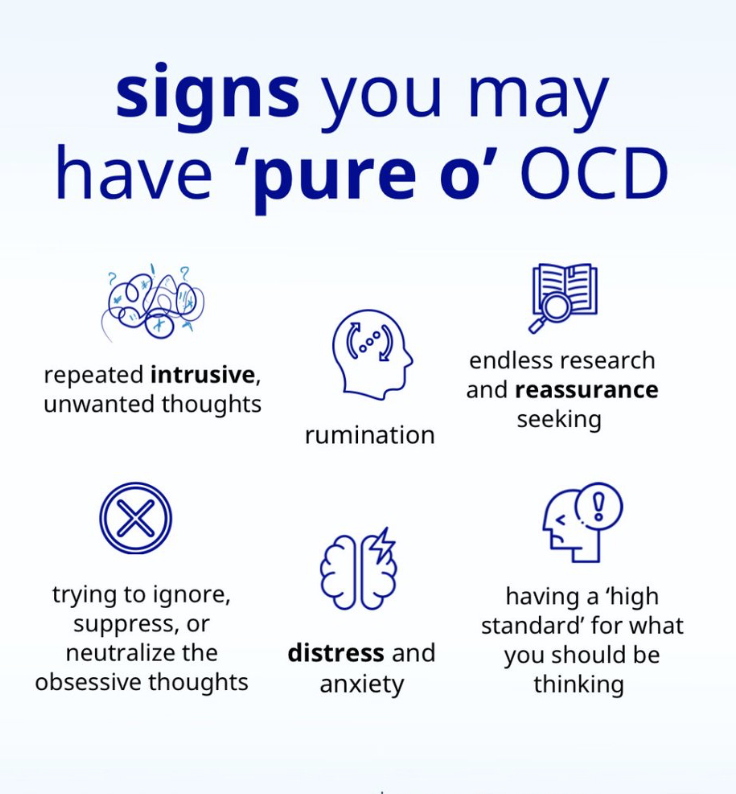
OCD doesn’t stay in a neat box, and your experience is valid even if it doesn’t fit perfectly into just one category, or fits best into more than one.
If any of this feels familiar, you’re not alone. And more importantly, there are real, effective ways to get support and start feeling more in control again.

Breaking down the subtypes of OCD
1. Hoarding OCD
Hoarding-related OCD centers around the fear of discarding something that could be useful, sentimental, or important in the future. Things start to pile up, go bad, or get lost, creating frustrations for you.
Hoarding and OCD can be separate entities, or they can be related.
Obsessions: Fear of losing something important, distress about discarding things
Compulsions: Saving, avoiding organization, acquiring multiples of the same item
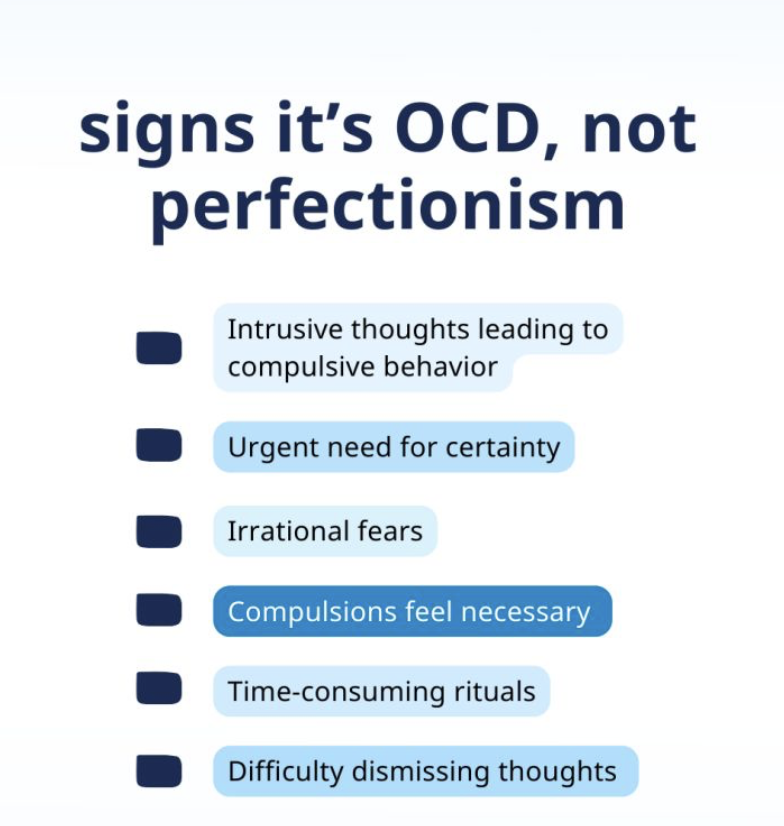
2. “Just right” / Perfectionism OCD
“Just right” or perfectionism OCD involves a constant need for things to feel perfect or complete.
If something feels off or unfinished to you, it can trigger distress until a sense of internal balance is restored.
This is distinct from carrying perfectionism as a personality trait.
If you experience perfectionism, you may find it irritating if you cannot quite accomplish things to your standards.
If you experience perfectionism OCD, you may need to keep redoing things until you are fully confident that they meet the standard that OCD tells you must be met.
Obsessions: Discomfort or anxiety unless things feel perfect.
Compulsions: Repeating actions, adjusting until it feels “just right”.
3. Relationship OCD (ROCD)
This form of OCD brings persistent doubts and fears about your romantic relationship.
You may question your feelings or whether your partner is truly “right” for you, even when things seem fine.
Again, this goes beyond the average levels of doubt and questioning that naturally occur in a relationship.
This becomes OCD when it is impeding your daily life and creating a lot of distress, and when it can only be soothed by giving in to certain thoughts or behaviors.
Obsessions: Doubts about your partner or the relationship.
Compulsions: Reassurance seeking, testing feelings, comparing to others, mentally reviewing moments.
4. Harm/Responsibility OCD
You may experience overwhelming fears that you could unintentionally hurt others or be responsible for terrible outcomes. These fears can dominate your decision-making and day-to-day behavior.
Maybe you are afraid that if you do not text your mom several times a day, she will get sick.
Obsessions: Fear of causing harm by accident or omission.
Compulsions: Confessing, retracing steps, checking the news or body signs.
5. Moral or scrupulosity OCD
This theme centers around fears of being morally wrong or spiritually impure. You might fear committing sins or being punished for bad thoughts, leading to compulsive efforts to feel morally “clean.”
This goes beyond the typical experience of religion.
You may feel an intense, paralyzing fear surrounding morality that needs to be soothed by a compulsion.
That’s when it moves past fear into OCD.
Obsessions: Fear of sinning or being immoral.
Compulsions: Excessive praying, confessing, avoiding certain topics or media.
6. Health OCD
Also known as hypochondria-related OCD, this theme focuses on fears that you have or will develop a serious illness. The anxiety leads to compulsive behaviors aimed at reassurance.
Perhaps you discover that your best friend is sick. Even though you haven’t seen her for several weeks, you still feel fear that you may get sick too.
You start to Google symptoms, take extra Vitamin C, and schedule a doctor’s appointment.
Obsessions: Fear of serious illness, misdiagnosis, or symptoms.
Compulsions: Googling symptoms, seeking medical reassurance, body-checking.
7. Magical thinking OCD
Magical thinking OCD makes you believe that your thoughts or small actions have the power to cause or prevent unrelated outcomes. You may feel immense responsibility for preventing harm through rituals.
This form of OCD can become extremely powerful if you feel that you have the power to prevent the harm of a loved one by performing a compulsion.
Obsessions: Belief that thoughts/actions can influence unrelated events.
Compulsions: Counting, tapping, mental rituals, avoiding certain numbers or words.
Which Type of OCD Do You Relate To Most?
As you read through these different types of OCD, you might have found yourself thinking, “Wait… that sounds like me.”
Those thoughts you can’t get out of your head that seem to dictate your life whether you like it or not suddenly have a possible explanation.
You may feel relieved.
You may also feel overwhelmed.
The important thing is that you have taken the first step.
If something in this list resonated with you, that’s worth paying attention to. And it could be a sign that getting support might really help you feel more steady and in control again.
How are different types of OCD diagnosed?
Diagnosing OCD is a multi-step process that examines what you’re experiencing and how much it affects your daily life.
Here’s what the diagnosis process for OCD often includes:
- Clinical interview: Your online therapist will ask about your current thoughts, behaviors, and experiences, including when they began and how they affect your life. They will also rule out other possible conditions.
- Yale-Brown Obsessive Compulsive Scale (Y-BOCS): This is a widely used and validated questionnaire that helps assess the severity and frequency of your obsessions and compulsions.
Getting an accurate diagnosis is an important step toward understanding how to manage OCD. With the right tools and support, making meaningful progress and regaining control over your thoughts and behaviors is possible.

OCD symptom management plan
The most effective way to manage OCD is through Cognitive Behavioral Therapy (CBT), particularly a specialized technique within CBT called Exposure and Response Prevention (ERP).
This approach focuses on teaching your brain that you can experience discomfort without needing to act on compulsions, which breaks the cycle that keeps OCD going.
Obviously, this may not be easy to imagine going through if you are experiencing OCD.
And yet it may also be your ticket to freedom.
Finding the strength to engage with ERP has been proven time and time again to allow you to be free from OCD, even more than medication.
What Is ERP Therapy?
Exposure and Response Prevention (ERP) is a type of cognitive behavioral therapy that helps individuals face their fears (exposure) without performing compulsions (response prevention), breaking the OCD cycle over time.
A strong OCD management plan usually includes:
- Psychoeducation: Learning how OCD works, including what keeps it going, gives you clarity and reduces shame.
- ERP (Exposure and Response Prevention): This involves gradually exposing yourself to obsessional triggers in a safe and controlled way while resisting the urge to perform your compulsions.
- Cognitive strategies: These strategies involve challenging unhelpful beliefs tied to your obsessions, like “If I think it, it must be true” or “I must prevent bad things from happening.”
- Mindfulness techniques: While not a replacement for ERP, mindfulness can help you observe your thoughts without reacting to them, making ERP more effective.
- Relapse prevention planning: Learning how to recognize early signs of OCD flares and having a plan in place to respond helps maintain your progress over the long term.
An example of ERP for types of OCD
If you’re afraid of contamination, ERP might involve touching a doorknob and not washing your hands immediately afterward.
You may wait five minutes the first time.
The following day, you may wait eight minutes.
That may have been more challenging than you anticipated, so you wait eight minutes again the following day.
The next day, you may feel stronger and push it to ten minutes.
Eventually, the fear lessens and the compulsion weakens. You begin to feel more and more confident about using doorknobs.
Now you can enter a building without needing to use a sleeve or tissue to cover the doorknob.
The embarrassment and stress is over. You can live free.
It took incredible strength and courage and you did it!
Key Takeaways
- OCD is more than cleanliness or organization. It involves intrusive thoughts (obsessions) and repetitive behaviors (compulsions) that can disrupt daily life.
- There are 4 commonly recognized types of OCD: contamination, checking, symmetry/order, and intrusive thoughts.
- OCD can show up in many different ways, including relationship OCD, health anxiety, moral scrupulosity, and more.
- Obsessions create anxiety, while compulsions provide temporary relief, reinforcing the cycle over time.
- You don’t need to fit into just one “type”. Many people experience overlapping OCD themes.
- Exposure and Response Prevention (ERP) is the most effective, research-backed treatment for OCD.
With the right support, OCD is manageable, and many people experience significant relief through therapy.

Find the OCD support you need with Makin Wellness
Understanding the types of OCD that may describe your compulsions and obsessions is just one part of the puzzle. With the right support and tools, you can change your relationship with your thoughts and gain control over your life.
Allowing your OCD compulsions dictate your movements can prevent you from getting the help you need. The good news is that online therapy with Makin Wellness can help you connect with an online therapist while maintaining comfort and safety in your own space.
Our online therapists regularly work with individuals experiencing OCD across Pennsylvania and understand the unique challenges of accessing specialized care in smaller communities.
Online therapy gives you a private, consistent space to:
- Learn about your OCD,
- Practice ERP with guidance,
- Build practical coping tools, and
- Set goals that reflect your values.
You deserve to feel empowered in your mental health journey. Help is here when you’re ready.
Your Makin Wellness online therapist can help answer any questions you have about the OCD symptoms you are experiencing. If you’re in Pennsylvania or anywhere in the U.S., you can connect with an online OCD therapist from the comfort of your home. Call us at (833)-274-heal or start here to schedule an appointment with one of our caring online therapists today.
Additional clinical review provided by Sean Ramos-Izquierdo, MA, LAPC, therapist at Makin Wellness.
More resources:
FAQs:
There are many different types of OCD, also called OCD subtypes or themes. While OCD is one diagnosis, it can show up in forms like contamination OCD, checking OCD, symmetry and order OCD, intrusive thoughts OCD, and more.
The four most commonly recognized types of OCD are contamination, checking, symmetry and order, and intrusive thoughts. These categories help explain how OCD shows up, and there are many additional forms of OCD people may experience.
The most common OCD types include contamination OCD, checking OCD, symmetry and order OCD, and intrusive thoughts OCD. Other types of OCD, like harm OCD or relationship OCD, are also widely experienced.
Yes, many people experience more than one of the different types of OCD at the same time. OCD symptoms often overlap, and your experience may include multiple themes or forms of OCD.
In all types of OCD, obsessions are intrusive thoughts, images, or urges that cause anxiety, while compulsions are behaviors or mental acts performed to reduce that anxiety. This cycle is what maintains OCD over time.
Yes. Regardless of the specific form of OCD, the most effective treatment is Exposure and Response Prevention (ERP). ERP helps break the cycle of obsessions and compulsions across all OCD types.
No. While contamination OCD is one of the most recognized types of OCD, many other forms exist. OCD can involve intrusive thoughts, fears of harm, relationship doubts, or moral concerns.
Leonardo DiCaprio has publicly discussed experiencing OCD symptoms while preparing for his role in The Aviator, where he portrayed Howard Hughes. His experience helped bring awareness to how different types of OCD can affect daily life.
If you think you may be experiencing one of the types of OCD, speaking with a mental health professional can help you get clarity and support. Early treatment can make managing symptoms much more effective.
Sources:
The scientific and clinical information in this article is based on established research and diagnostic criteria from a unified body of peer-reviewed sources, including:
- American Psychiatric Association (2013). Diagnostic and Statistical Manual of Mental Disorders, Fifth Edition (DSM-5). Arlington, VA: American Psychiatric Publishing.
https://archive.org/details/APA-DSM-5 - Foa, E. B., et al. (2005). Randomized, Placebo-Controlled Trial of Exposure and Ritual Prevention, Clomipramine, and Their Combination in the Treatment of Obsessive-Compulsive Disorder. American Journal of Psychiatry, 162(1), 151–161.
https://www.med.upenn.edu/ctsa/assets/user-content/documents/Foa-ClomipramineRCT05.pdf - Pauls, D. L., et al. (2014). Obsessive-Compulsive Disorder: An Integrative Genetic and Neurobiological Perspective. Nature Reviews Neuroscience, 15(6), 410–424.
https://europepmc.org/article/MED/24840803 - Cromer, K. R., et al. (2007). An Investigation of Traumatic Life Events and Obsessive-Compulsive Disorder. Behaviour Research and Therapy, 45(7), 1683–1691.
https://public.websites.umich.edu/~prestos/Consumption/pdfs/Cromeretal2007.pdf - Abramowitz, J. S., & Arch, J. J. (2014). Strategies for Improving Long-Term Outcomes in Cognitive Behavioral Therapy for Obsessive-Compulsive Disorder: Insights From Learning Theory. Cognitive and Behavioral Practice, 21(1), 20–31.
https://jonabram.web.unc.edu/wp-content/uploads/sites/2968/2013/09/Abramowitz-Arch-2013-Improving-CBT-for-OCD.pdf - Hertenstein, E., et al. (2021). Mindfulness-Based Cognitive Therapy for Unmedicated Obsessive-Compulsive Disorder: A Randomized Controlled Trial With 6-Month Follow-Up. Frontiers in Psychiatry, 12, 661807.
https://www.frontiersin.org/journals/psychiatry/articles/10.3389/fpsyt.2021.661807/full







This Post Has 9 Comments
OCD is explained very well. Thanks
Hello Shivam, thank you for your feedback!
This post is incredibly informative! The explanation of the 4 different types of OCD is thorough and easy to understand. The writing style is clear and the information is presented in a way that is both educational and approachable. I appreciated the insight into a complex and often misunderstood condition. Thank you for shedding light on OCD and for providing such a valuable resource.
Hi Soniya, thank you for your feedback!
Can chewing noise be an ocd
Thanks so much for your question! Having difficulty with chewing noises can be included under OCD or other related disorders, but that isn’t an exclusive categorization. A licensed therapist can better determine that based on other criteria that would be covered within a counseling session.
Have a nephew who is terrified of germs but doesn’t have excessive cleaning behaviours.In fact he refused to shower.Doesnt sound like typical OCD.
Can someone develop more than one type of OCD?
Great question, Walter. You can have one main type of OCD or have symptoms of multiple types of OCD. The type of OCD can change over time, as well. The fact that a person’s OCD can morph over time makes it even more important to get to the root of the OCD through therapy and not just treat the symptoms.