
What is Obsessive-Compulsive Disorder (OCD)?
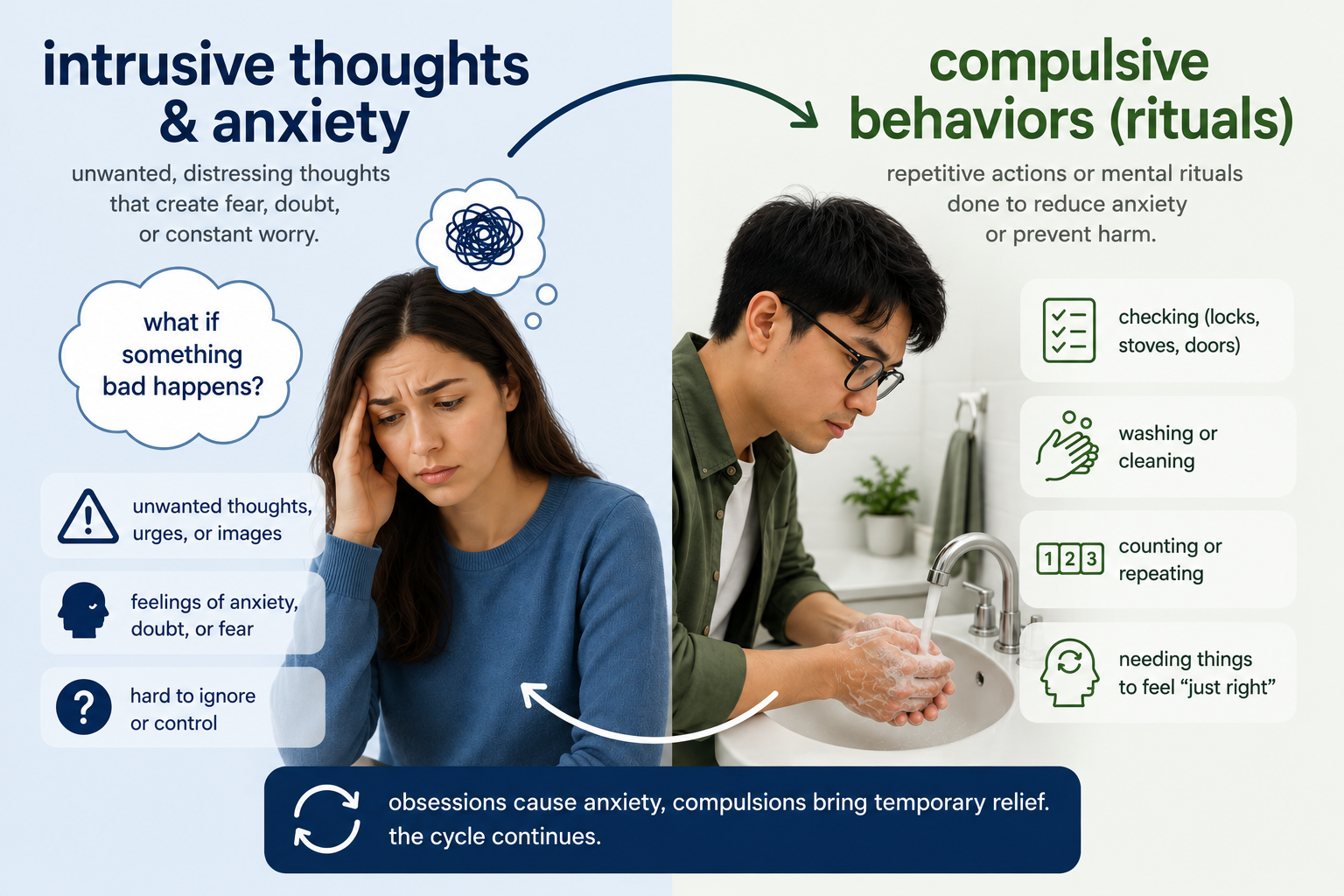
Obsessive-Compulsive Disorder, commonly called OCD, is a mental health condition that causes unwanted intrusive thoughts (obsessions) and repetitive behaviors or mental rituals (compulsions). When living with OCD, you often feel trapped in a cycle where compulsions temporarily reduce the anxiety caused by obsessive thoughts.
OCD is much more than being “organized” or “clean.” It can involve distressing fears, constant doubt, intrusive thoughts, checking behaviors, reassurance-seeking, contamination fears, and other symptoms that interfere with daily life, relationships, work, and emotional well-being.
Suffering from OCD can feel exhausting. One moment, you may be trying to focus on work, school, or family, and the next, intrusive thoughts take over your attention. You may find yourself repeatedly checking, cleaning, seeking reassurance, avoiding certain situations, or mentally replaying events just to feel temporary relief.
Even when you recognize that your fears may not be logical, OCD can still feel overwhelming and very real.
The good news is that OCD is highly treatable. One of the most effective approaches is cognitive behavioral therapy for OCD, especially a specialized form called Exposure and Response Prevention (ERP), which helps you reduce compulsions and respond differently to intrusive thoughts and anxiety.
If you’ve been wondering whether online therapy can help break the cycle of obsessions and compulsions, this guide will walk you through what to expect from treatment and how therapy can support long-term symptom management.
What Is Cognitive Behavioral Therapy for OCD?
Many people ask: What is cognitive behavioral therapy for OCD?
Cognitive behavioral therapy (CBT) is a type of talk therapy that helps you understand how your thoughts, emotions, and behaviors are connected. For OCD specifically, CBT focuses on helping you respond differently to intrusive thoughts instead of becoming trapped in compulsive behaviors.
When you live with OCD, you often experience:
- Repetitive unwanted thoughts
- Intense anxiety or fear
- Urges to perform rituals or compulsions
- Difficulty tolerating uncertainty
- Guilt, shame, or fear of causing harm
CBT helps break this cycle.
Instead of trying to “get rid” of every intrusive thought, online therapy teaches you how to:
- Recognize OCD patterns
- Reduce compulsive behaviors
- Manage anxiety more effectively
- Build tolerance for uncertainty
- Regain confidence in everyday life
One of the most effective forms of cognitive behavioral therapy for OCD is called Exposure and Response Prevention (ERP), which we’ll discuss later in this article.
Understanding OCD beyond stereotypes
You might be thinking that OCD is just about cleanliness or organization. In reality, OCD can affect nearly every area of your life.
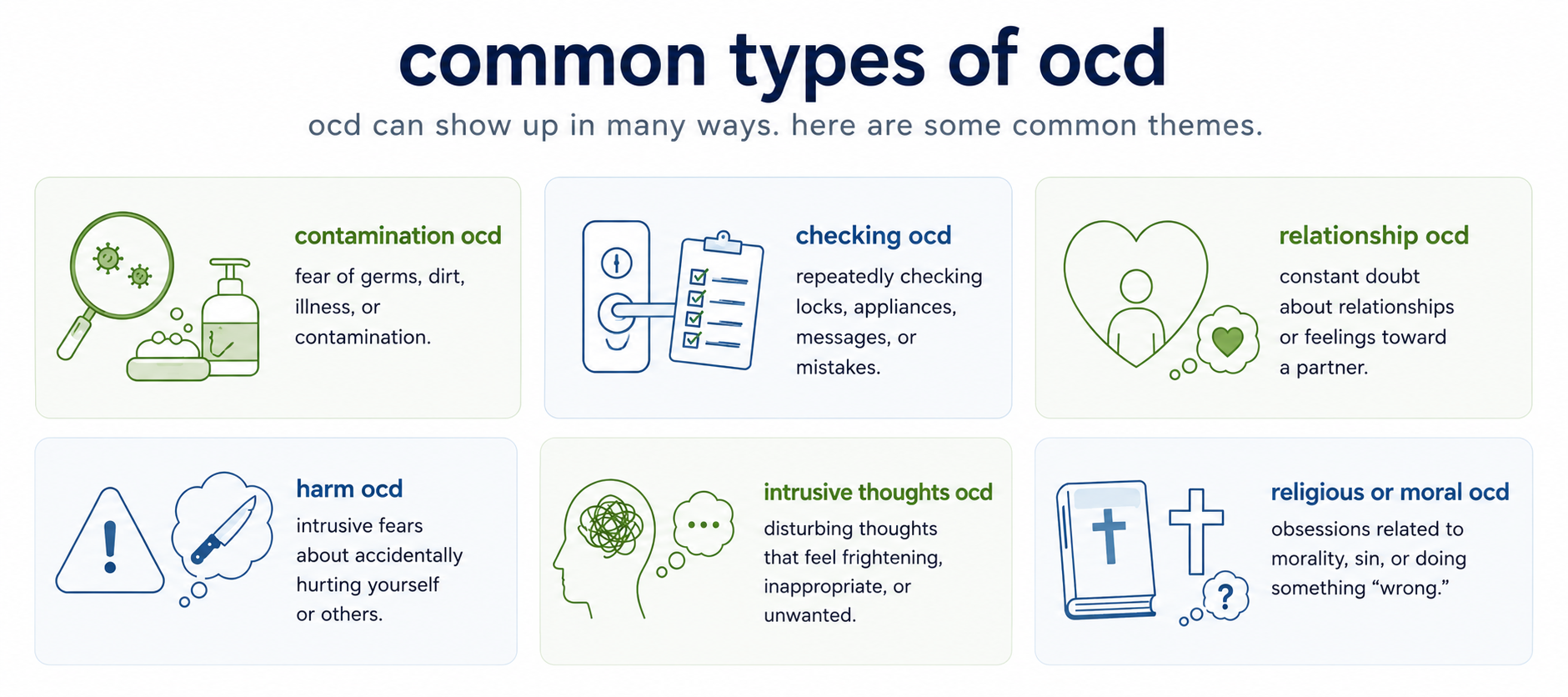
Some common OCD themes include:
Contamination OCD
Fear of germs, illness, dirt, or contamination.
Checking OCD
Repeatedly checking locks, appliances, messages, or mistakes.
Harm OCD
Intrusive fears about accidentally hurting yourself or others.
Relationship OCD
Constant doubt about relationships or feelings toward a partner.
Religious or moral OCD
Obsessions related to morality, sin, or doing something “wrong.”
Intrusive thoughts OCD
Disturbing thoughts that feel frightening, inappropriate, or unwanted.
These thoughts can feel deeply upsetting, and having intrusive thoughts does not mean you want them to happen. In fact, when you live with OCD, you are often distressed precisely because the thoughts go against your values.
How Cognitive Behavioral Therapy for OCD works
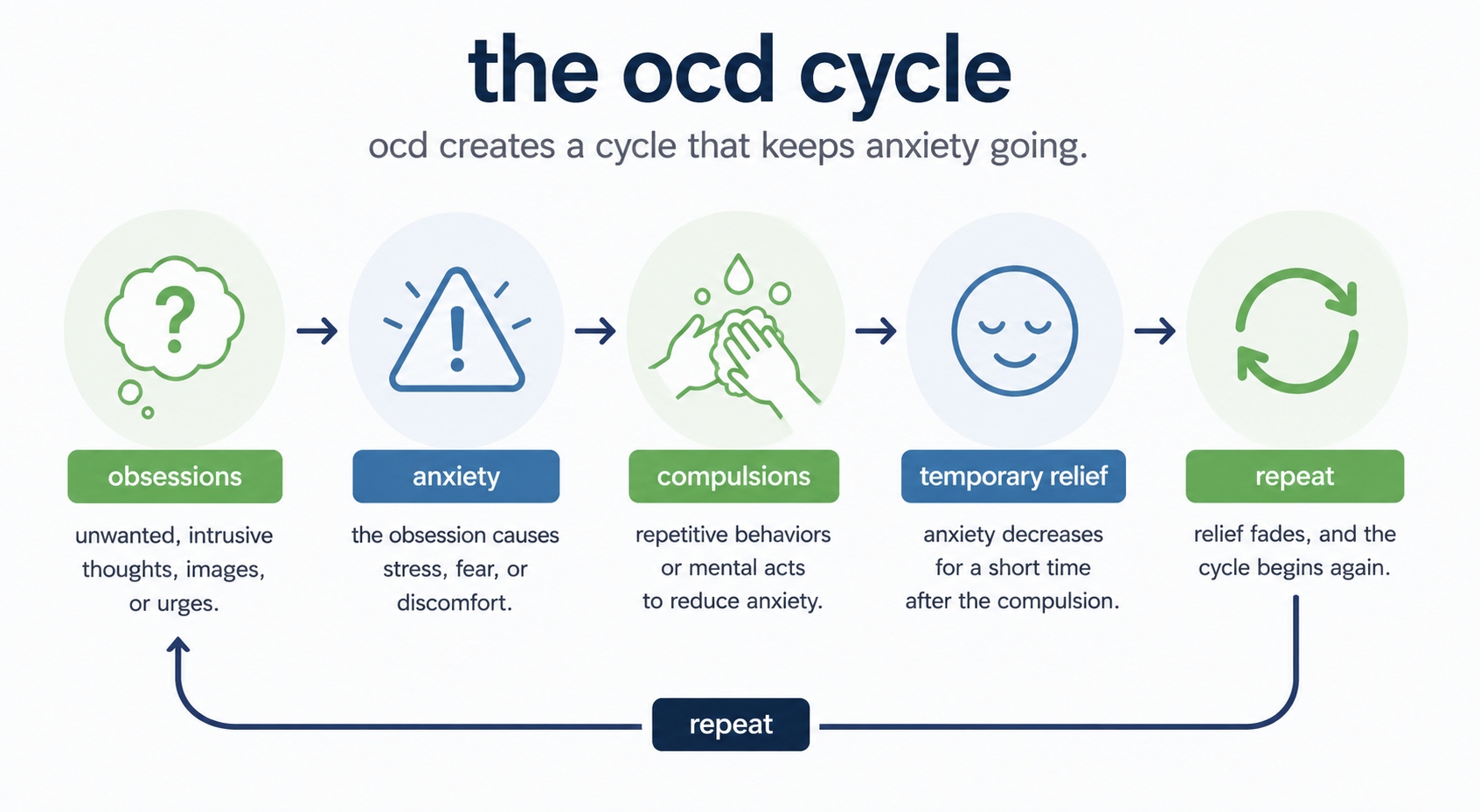
Cognitive behavioral therapy for OCD works by interrupting the cycle between:
- Obsessions
- Anxiety
- Compulsions
- Temporary relief
At first, compulsions may seem helpful because they reduce your anxiety for a short time. Over time, they actually strengthen your OCD.
For example:
- You have a fear that the door is unlocked.
- Anxiety increases.
- You check the lock repeatedly.
- Anxiety briefly decreases.
- Your brain learns that checking is necessary.
The cycle repeats again and again.
CBT helps retrain the brain so you no longer rely on compulsions to feel safe.
The role of Exposure and Response Prevention (ERP)
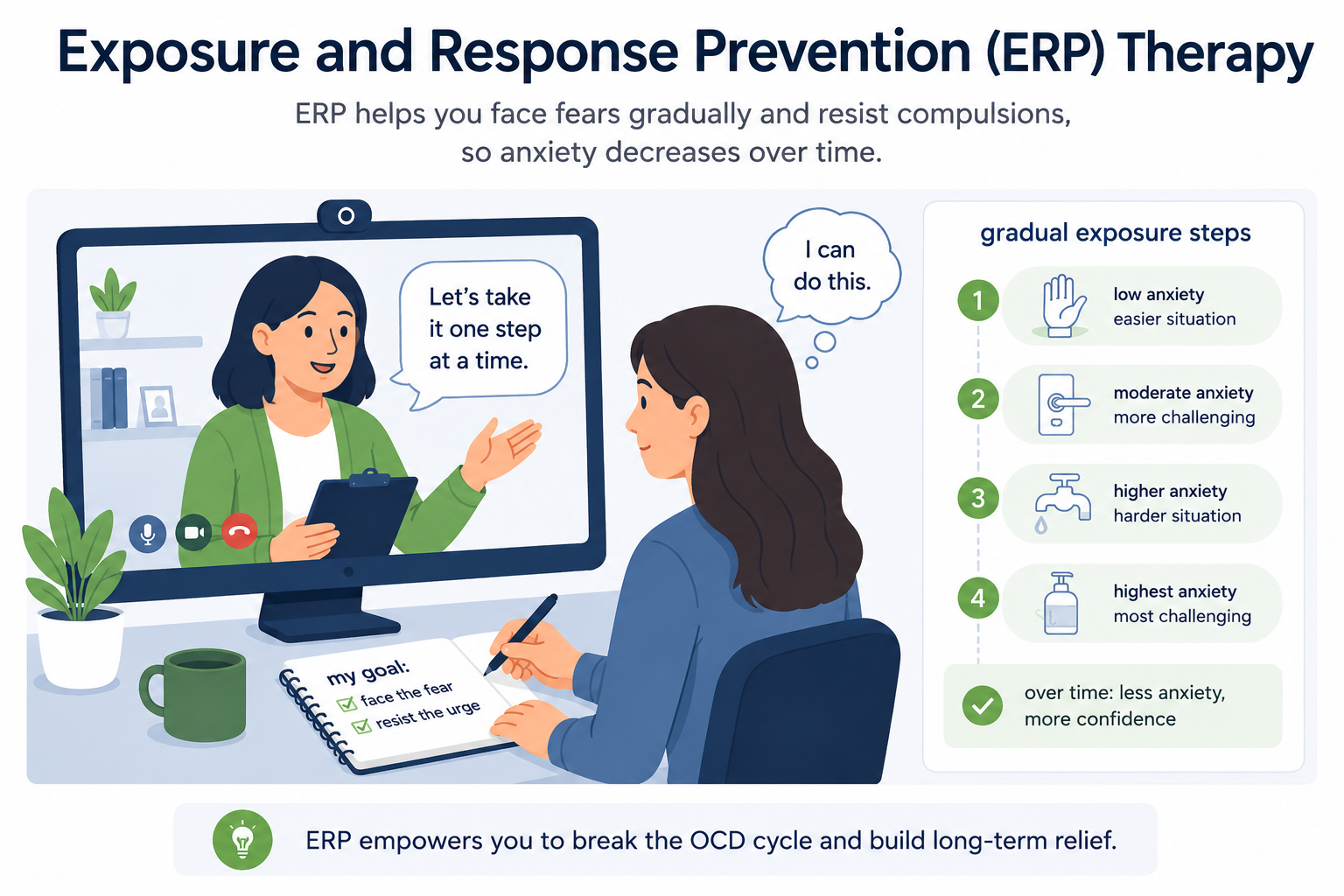
When discussing cognitive behavioral therapy for OCD, ERP is considered the gold standard treatment.
ERP involves:
- Gradually facing fears or triggers
- Resisting compulsive responses
- Learning that anxiety naturally decreases over time
For example:
- If you live with contamination OCD, you may practice touching a surface without immediately washing your hands.
- If you struggle with checking OCD, you may leave your house without repeatedly checking the stove.
- If you have intrusive thoughts, you may learn not to seek reassurance after a distressing thought appears.
This process helps your brain learn:
“I can handle uncertainty without performing compulsions.”
ERP is done gradually and collaboratively with a trained therapist. It is not about forcing you into overwhelming situations. Online therapy moves at a manageable pace based on your comfort and goals.
Why Cognitive Behavioral Therapy for OCD is so effective
Research consistently shows that CBT, especially ERP, is one of the most effective treatments for OCD.
Here’s why it works:
1. It targets the root cycle of your OCD
Instead of only talking about your feelings, CBT focuses on the actual patterns maintaining OCD symptoms.
2. It builds long-term skills
Online therapy teaches coping tools you can continue using long after sessions end.
3. It reduces avoidance
Avoidance may feel protective, and it often makes anxiety stronger over time. CBT helps you gradually re-engage with your life.
4. It helps you tolerate uncertainty
One of the biggest struggles in OCD is the need for certainty. CBT teaches that while uncertainty is uncomfortable, it is survivable.
5. It improves daily functioning
As compulsions decrease, you start to notice improvements in your relationships, work, sleep, concentration, and overall quality of your life.
What happens during sessions of Cognitive Behavioral Therapy for OCD
If you’ve never tried online therapy before, you might wonder what sessions actually look like.
While every therapist has a different style, cognitive behavioral therapy for OCD often includes:
Learning about OCD
You’ll better understand how OCD works and why compulsions keep the cycle going.
Identifying your triggers
Your therapist may help identify situations, thoughts, or feelings that activate your OCD symptoms.
Tracking patterns
You may notice recurring obsessions, compulsions, reassurance-seeking, or avoidance behaviors.
Creating an exposure plan
Together, you and your therapist build gradual ERP exercises based on your goals.
Practicing new responses
Instead of reacting automatically to OCD fears, you’ll practice healthier responses.
Building confidence
Over time, you will feel more capable of handling anxiety without rituals.
Online therapy is not about becoming “perfect.” It’s about reducing OCD’s control over your life.
Common misconceptions about Cognitive Behavioral Therapy for OCD
“Online therapy will make me face my worst fears immediately.”
Good online therapy moves gradually. You and your therapist work together at a manageable pace.
“If I stop compulsions, something bad will happen.”
This fear is common in OCD. CBT helps you test those fears safely and realistically.
“Intrusive thoughts mean I’m dangerous.”
Intrusive thoughts are extremely common in OCD and do not define your character.
“I should be able to handle this on my own.”
OCD can be incredibly isolating, but seeking support is not a weakness. Professional help can make a major difference.
Signs you may benefit from Cognitive Behavioral Therapy for OCD
You may benefit from online therapy if you:
- Spend large amounts of time on rituals or compulsions
- Feel trapped in repetitive thoughts
- Constantly seek reassurance
- Avoid situations due to fear or anxiety
- Experience distressing, intrusive thoughts
- Struggle with uncertainty
- Notice OCD interfering with work, school, sleep, or relationships
Even mild OCD symptoms can become overwhelming over time without support.
Can online therapy help OCD?

Yes — online therapy can be highly effective for OCD treatment, including therapy delivered through video sessions. Research has shown that teletherapy using Exposure and Response Prevention (ERP), a specialized form of cognitive behavioral therapy for OCD, can significantly reduce OCD symptoms in children and adolescents.
Virtual therapy can be effective because it offers:
- Greater convenience
- Flexible scheduling
- Access to specialized therapists
- More comfort during sessions
- Reduced travel stress
Online therapy may even improve ERP work because exposures can happen directly in real-life environments at home. This can help therapy feel more practical and personalized to everyday situations.
Whether you’re balancing work, parenting, school, or a busy schedule, virtual therapy can make OCD support more accessible while still providing evidence-based care.
How long does Cognitive Behavioral Therapy for OCD take?
There is no single timeline for OCD treatment.
You may start to notice improvements within a few months, or sometimes, you may benefit from longer-term support, depending on:
- OCD severity
- How long have symptoms been present
- Consistency with online therapy exercises
- Co-occurring anxiety or depression
- Stress levels and life circumstances
The important thing to remember is that progress is possible.
Progress doesn’t mean intrusive thoughts disappear completely. It means those thoughts no longer control your life the way they once did.
Tips for supporting yourself between online therapy sessions
Online therapy is most effective when skills are practiced consistently.
Here are a few ways to support yourself outside sessions:
Practice resisting reassurance
Repeated reassurance often strengthens OCD over time.
Allow discomfort
Anxiety naturally rises and falls. You don’t always need to “fix” it immediately.
Limit compulsions gradually
Small steps matter.
Be patient with yourself
Progress takes time.
Celebrate progress
Even small victories deserve recognition.
The emotional impact of OCD
Living with OCD can also contribute to emotional challenges such as:
- Shame
- Isolation
- Fear of judgment
- Frustration
- Exhaustion
Because intrusive thoughts can feel deeply personal, you may often avoid opening up about them.
OCD is more common than you realize, and effective treatment exists.
You do not have to manage it alone.