
Childhood trauma can continue to affect your thoughts, relationships, and behavior well into adulthood – often in ways you don’t immediately recognize. Unprocessed childhood trauma may lead to anxiety, low self-esteem, chronic stress, or self-sabotaging patterns meant to protect you from emotional pain.
The good news is that moving forward is possible. With trauma-informed online therapy, mindfulness practices, and supportive coping strategies, you can process childhood trauma, reduce its impact, and move toward a healthier, more fulfilling life.
Childhood is ideally a time of joy, learning, and innocence. For many, it carries the heavy burden of traumatic or abusive experiences. Whether you’ve recently awakened to your past experiences or you’ve known about your past and want to unravel the effects of your childhood trauma, this post can help you both to identify the symptoms of childhood trauma in adulthood and to learn how to overcome it. .
In recent years, more adults are recognizing how childhood trauma shows up later in life – especially as conversations around mental health, boundaries, and emotional safety have become more mainstream.
Specifically, this article will cover what childhood trauma looks like, what ACES are, and how they measure childhood trauma, how unprocessed trauma can affect you, how childhood trauma can lead to self-sabotage, a free test to determine if your childhood trauma is affecting you in adulthood, and how to cope with your experiences to live a more fulfilling, happy life.
What does childhood trauma look like?
Childhood trauma is the experience of intensely stressful events that shatter your sense of security, making you feel helpless and vulnerable in a world that should provide safety. It casts long shadows into adulthood, often shaping your personality and behavior in intricate ways.
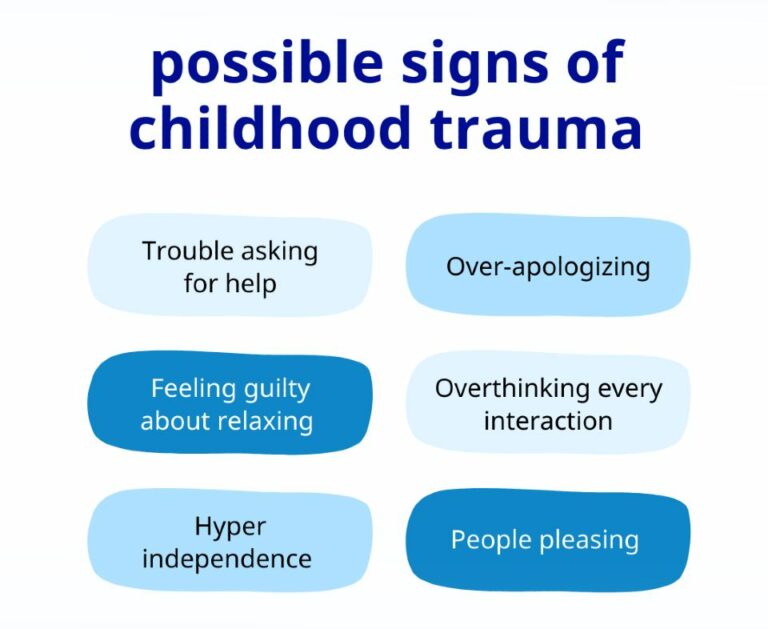
Like many adults with childhood trauma, you might not even recognize it as trauma at all. Instead, it shows up as people-pleasing, hyper-independence, chronic anxiety, or an inability to relax – even when your life is stable.
Different forms of ACES childhood trauma include:
- Emotional abuse: This includes consistently belittling, shaming, and humiliating you.
- Physical abuse: Any form of physical harm intentionally inflicted on you.
- Sexual abuse: An adult using a child for sexual purposes.
- Neglect: Failure of a parental figure to meet your basic needs, including housing, food, clothing, education, and access to medical care.
- Witnessing violence: Seeing acts of violence or living in violent environments.
No form of abuse is more or less abusive than another. Each form of abuse holds specific importance in the development of your brain and, in turn, impacts your worldview.
For example, you may feel that if you experienced emotional abuse, it isn’t as bad as experiencing physical abuse. Because of this belief, you may downplay the abuse and the effects the abuse has caused you. Nevertheless, both forms of abuse can cause long-lasting effects if they are not treated and processed. Know that any kind of abuse is not ok, and is always worthy of seeking help.
When most people talk about childhood trauma, they assume that the trauma happens due to parental abuse. There is another aspect of childhood trauma that needs to be discussed: environmental trauma. This can include natural disasters, losing a parent or friend, being bullied or socially isolated in school, and being part of the foster care system. If you have experienced any of these forms of childhood trauma, online therapy can provide the space to begin to process the symptoms of childhood trauma in adulthood that are impacting you.
With this in mind, let’s look at some examples of abuse and environmental trauma.
Examples of childhood trauma include:
- Seeing domestic violence in your home.
- Experiencing food insecurity.
- Being emotionally manipulated, shamed, or humiliated by a parent.
- Witnessing a tragedy like a car accident, a house fire, or death.
- Being beaten, hit, slapped, or experiencing other severe forms of physical harm.
- Experiencing the loss of a parent or loved one.
- Living through a flood, tornado, shooting, or a terrorist attack.
- Experiencing unpredictable parental behaviors and mood swings due to substance abuse or mental health issues.
- Constantly moving and not having a stable home.
This list is just a snapshot of examples of trauma you may have experienced as a child. Remember that abusive behaviors or traumatizing events can be subtle, as well. No matter what you have experienced, know that your feelings are valid, and you deserve to be free from the harm of past events.
What are ACEs childhood trauma?
The ACEs childhood trauma framework helps both professionals and survivors to have a better understanding of how childhood trauma impacts them. The term ‘ACEs’ refers to Adverse Childhood Experiences. This means that anything that you have experienced in your childhood that was deeply harmful to you should be accounted for by ACEs. This could range from a teacher who consistently belittled you to living through a severe flood.
Similarly, the ACEs Scale is a specific tool used to assess levels and types of childhood trauma. The ACEs test measures the impact of ACEs childhood trauma, helping identify specific areas where early adversity may still be influencing your adult life.
It’s similar to a personality test like the Myers-Briggs or the DISC assessment, only, in the hands of a therapist, it can help you and your therapist to discover what type of childhood trauma has been affecting you.
There are ten unique categories in ACEs, which include the following:
- Emotional abuse
- Physical abuse
- Sexual abuse
- Emotional neglect
- Physical neglect
- Household substance abuse
- Household mental illness
- Parental separation or divorce
- Domestic violence
- Incarceration of a household member
If you feel that you have experienced anything that ACEs describe in your own childhood, it can feel daunting.
Perhaps you have been haunted by memories or patterns that feel deeply ingrained for a long time. You deserve to experience freedom from painful memories and habits shaped by childhood trauma.
You are so much more than your trauma.
Don’t be afraid to reach out for specialized online therapy to begin finding freedom today.
How does childhood trauma affect adulthood?
The repercussions of unaddressed childhood trauma can affect numerous aspects of your life into adulthood.
Let’s look at some effects that unprocessed traumatic events can have on you from childhood to adulthood. Many adults facing anxiety, depression, or trust issues are often dealing with the lingering effects of ACEs childhood trauma that went unprocessed for years.
Mental health issues from unprocessed trauma include:
- Anxiety
- Depression
- Post-Traumatic Stress Disorder (PTSD)
- Substance abuse
Insecurities and emotional struggles from unprocessed trauma include:
- Low self-esteem
- Struggling to trust others
- Unexplained feelings of shame and guilt
- Persistent fear and feelings of being unsafe
You may be surprised to learn that, depending on when you experienced childhood trauma, you may be impacted by inflammation as an adult. One of the symptoms of childhood trauma in adulthood can be physical inflammation
In fact, another symptom of childhood trauma in adulthood can manifest physically through autoimmune diseases. Another recent scientific study found a clear link between autoimmune diseases and childhood trauma in women.
If you have been noticing that your body feels as overwhelmed as your brain, the culprit for both (at least, in part) may be childhood trauma.
The lasting effects of unprocessed trauma can cause different types of distress well into adulthood. Looking at these thoughts and feelings, you can see how they affect how you see yourself and other areas like relationships, career, and achieving your goals.
Overcoming the ways unprocessed childhood trauma impacts your daily life is possible.
You may be frustrated by the fact that you can’t seem to go on more than one or two dates with the same guy. Maybe you’re tired of feeling like you’re constantly in fight or flight, even when you’re just scrolling on Instagram. Maybe you are ready to be done with constantly battling poor self-talk.
Believe it or not, you are more than capable of moving forward with success, especially with the coaching and care that online therapy provides.

How childhood trauma causes self-sabotage
Unprocessed childhood trauma can become the blueprint for adult behaviors – often, ones that can make you self-sabotage.. This is one of the greatest symptoms of childhood trauma in adulthood.
What is self-sabotage?
Self-sabotage is any action or thought that keeps you from achieving your goals and living a fulfilling life. It can take many forms, including:
- Unhealthy self-talk
- Procrastination
- Avoiding opportunities for growth and success
- Engaging in harmful behaviors like drug use, excessive drinking, or unhealthy eating habits
Childhood trauma can lead to self-sabotaging behaviors. How is this possible? Sometimes, self-sabotaging behaviors are a way to cope with intense emotions and feelings of insecurity. They can also stem from a deep-rooted belief that you are not worthy or deserving of happiness and success due to past experiences.
Examples of self-sabotage in adults with childhood trauma include:
- Not applying for your dream job because you don’t believe you are qualified.
- Sabotaging a romantic relationship because of fear of abandonment or intimacy issues
- Avoiding seeking help for mental health struggles due to stigma or feelings of shame and guilt
- Engaging in risky behaviors as a way to numb emotional pain
- Choosing partners who display abusive behaviors because you believe they are the only ones who could love you perpetuates the cycle of abuse.
Thankfully, just the act of recognizing these patterns is the first step towards breaking the cycle and carving a path toward a life you envision for yourself. It’s time to take charge and stop letting self-sabotage stand between you and your best life.

Childhood trauma test: Is childhood trauma holding you back?
It’s challenging to confront the possibility that your childhood experiences may affect your present lifestyle. Way to take the first step by taking this short childhood trauma test!
Ask yourself these questions to begin taking back your life from childhood trauma:
- Do you find yourself repeating patterns that prevent personal or professional growth?
- Are your relationships often tumultuous or unfulfilling?
- Do you struggle with self-care?
- Do you struggle with setting healthy boundaries?
- Is there a persistent sense of fear, shame, or unworthiness that you can’t explain?
- Do you often avoid opportunities or social interactions due to intense anxiety or a lack of trust?
These questions aim to reflect on behaviors and emotions that may arise from unresolved trauma. If you answered yes to any of these questions, finding guidance from a specialized trauma therapist online can be imperative to resolving your past experiences and working through the emotions that keep you stuck at the time of abuse.
Think of it this way: As a child, you are a learning machine. Everything you feel, see, taste, touch, and listen to is absorbed by your brain like a sponge.
That first memory of rainboots, puddles, and mud during that storm; your favorite kind of cookie growing up; the song that was ‘your song’ in middle school… they all form and shape who you are.Your experiences – the ones you treasure, the ones that are painful, and everything in between – are programming your brain to understand the world around you.
If, during your childhood, you experienced abuse, a traumatic event, or consistent distress, your programming will reflect your experiences. Even if the traumatic event or abuse is far from you as an adult, you still hold tight to the messages you received at the time of the traumatic event. It’s part of being that learning machine as a child.
For example, if your parent made you feel like your voice wasn’t worth hearing as a child, you may still believe that no one wants to listen to what you have to say, even in your 30s or 40s. Regardless of it being a false belief, you still believe it because it is what you know from your past experiences.
Makin Wellness online trauma therapy and coping skills can help you untangle the mixed messages you carry to create a healthy self-image and worldview. With online therapy, it is possible to reprogram yourself as a learning machine in a healthy way and achieve a better life.

How to overcome childhood trauma
Overcoming childhood trauma is a nuanced process unique to you.
This process isn’t just possible – it can actually lead to PTG (Post-Traumatic Growth). Studies interviewing survivors of the Iran-Iraq war, for example, demonstrate this. Those findings mean that even though you might have lived through intense brutality, with the right support, you could learn how to harness your pain and turn it into a tool to help you achieve a better life. Your future does not have to look like constantly trying to keep your head above water. You can move forward stronger, braver, and kinder with the right tools and support.
Ready to start? These practices can serve as general guidelines for beginning the journey to overcoming your childhood trauma.
- Online therapy: Working with a specialized Makin Wellness online therapist can provide the safe space needed to process your childhood trauma experience and find healthy ways to move forward. Having an online therapist who can listen to all of your experiences without judgment and offer advice that is tailored specifically to you and your journey is an incredible resource to help you overcome childhood trauma.
- Mindfulness and meditation: These practices can help ground you in the present and alleviate stress. Even just five minutes of meditation can make an amazing impact on your day. Want to elevate your mindfulness and meditation game? Make your favorite hot drink and light a candle, or go outside and sit in nature. Both can work wonders. An online therapist can also help you to find the optimal mindfulness and meditation routine for your lifestyle.
- Expressive writing: Journaling or creative writing can be cathartic and help you process feelings that are challenging to say out loud. It’s an incredible resource to help you to take a knot of complex experiences, memories, and feelings and start to unravel them. This powerful tool allows you to process trauma in a different way than simply speaking things out loud.
- Expressive drawing: Another powerful way to work on processing childhood trauma is to draw. Your emotions may be too complex and tangled to write about yet. And if you don’t enjoy writing, you may find it easier to connect with yourself through drawing. If drawing sounds like a more natural fit, grab your favorite drawing tool and get to work! Anything from abstract and raw pieces, to comics detailing your feelings through a character’s eyes, to a coloring book can be helpful ways to process.
- Support groups: Connecting with others with similar experiences can foster understanding and help you feel less alone with the feelings you are experiencing. You may find it especially encouraging to discover other people who have also been working to overcome how their childhood affects them in adulthood. If you’re not sure where to find a support group, your online therapist can help.
Because childhood trauma is layered and complex, it is imperative to include online therapy in your coping strategies.
A Makin Wellness online therapist can offer support, delving into areas such as repressed memories and patterns of self-sabotage, helping you to establish a secure environment for healing. They’re trained to ask probing questions that bring hidden wounds to light, facilitating a path to rediscover and reclaim the parts of yourself that may have been lost or obscured by trauma.
Moving on from Childhood Trauma
Childhood trauma can affect every corner of your adult life, from self-perception to how you interact with the world, from relationships to your professional career. If you recognize the echoes of childhood trauma in your present life, know that there is help available through online therapy to guide you through understanding your experiences, coping with areas that are challenging for you, and creating the safe space you need to move forward with confidence.
Overcoming childhood trauma doesn’t mean forgetting the past. It often means developing a new relationship with yourself – one rooted in safety, self-trust, and compassion.
Makin Wellness offers specialized online therapists attuned to the sensitivities of childhood trauma. If you are ready to start your online therapy journey, call (833)-274-heal or schedule an appointment to connect with a compassionate professional dedicated to helping you move from merely surviving to truly thriving.