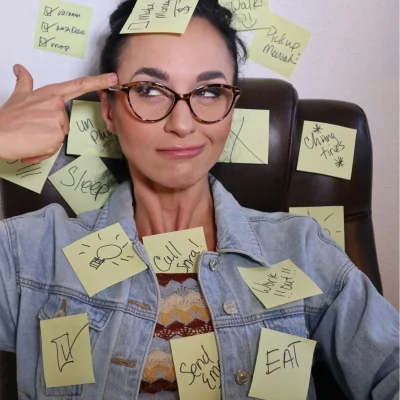
ADHD symptoms in women often look nothing like the stereotypes. They show up as executive dysfunction (challenges with planning, prioritizing, and managing time), emotional overwhelm, chronic disorganization, and a deep internal restlessness that others rarely see. The most effective support comes through specialized online therapy that understands how ADHD uniquely impacts women’s lives.
You’ve been hiking and you come across a waterfall. As you admire it, it suddenly hits you that you can get up close to it. Its majesty, predictable unpredictability, and sheer noise is stunning.
Then you realize that your life is a lot like a waterfall.
Think about it this way: the water crashes over you constantly: the mental to-do lists, the forgotten appointments, the guilt over how you snapped at your daughter this morning. The noise is relentless. You try to think clearly, to plan, to focus, and all you feel is the spray hitting your face while the world around you blurs. Life is beautiful…and chaotic.
Now imagine stepping behind that waterfall. The noise doesn’t disappear entirely. Instead, it softens into a low hum. You can breathe. You can see. There’s space to sort through what’s actually happening in your brain without the overwhelm of it all crashing down at once.
That’s what understanding your ADHD symptoms can feel like. And that’s what this article is here to offer you: a quiet space behind the noise.
What Is ADHD?
Attention-Deficit/Hyperactivity Disorder (ADHD) is a neurodevelopmental condition that affects executive function: your brain’s ability to plan, prioritize, manage time, regulate emotions, and follow through on tasks. It is not a character flaw, a laziness issue, or something you can simply “try harder” to overcome.
What does ADHD actually look like in women?
You remember that one kid in your class. He was always fidgeting, talking out, getting sent to the principal’s office, taking stuff apart, getting out of his seat… the list goes on. If you grew up hearing that ADHD means a hyperactive boy bouncing off classroom walls, you may have never considered that your own struggles could be caused by ADHD.
The signs of ADHD in females aren’t always obvious to the people around them. While some girls and women experience visible hyperactivity, others learn early how to hide, compensate for, or work around their struggles.
In other words, ADHD symptoms in women tend to be more internal, more emotional, and more invisible. Often, they look nothing like the stereotypical hyperactive elementary school boy! You may have spent years developing coping strategies that mask what’s really happening beneath the surface.
Here’s what the signs of ADHD in females often look like in everyday life:
- The mental noise never stops. Your brain has 47 tabs (or more) open at all times…plus mental background music. You’re thinking about the meeting tomorrow, the permission slip you forgot, and whether you remembered to switch the laundry… all while someone is talking to you.
- You start strong and stall out. Projects, routines, even conversations. You’re full of ideas and energy at the beginning, and then something invisible pulls the plug. This is often called ADHD paralysis: feeling frozen despite desperately wanting to move forward.
- Emotional intensity that others don’t seem to share. A small criticism doesn’t just sting. It spirals. You replay it for hours, days. The emotional weight of everyday interactions can feel crushing.
- Chronic lateness and time blindness. You genuinely intend to be on time. You plan for it. And somehow, every single morning feels like a frantic sprint to the door.
- “Object permanence” challenges. Out of sight truly becomes out of mind. Bills, friendships, leftovers in the fridge: if you can’t see them, they may as well not exist.
- Masking exhaustion. You’ve learned to appear organized, calm, and “together” in public. Meanwhile, internally, you’re running on fumes just to keep up the performance.
If you’re reading this list and nodding in agreement, then let’s take a minute to look a little closer at the waterfall of your life.
Why are ADHD symptoms in women so often missed?

For decades, ADHD research focused primarily on young boys. That’s why a lot of us grew up with that as the stereotype of ADHD in our minds. The diagnostic criteria were built around external behaviors like physical hyperactivity, impulsivity in the classroom, and disruptive conduct. As we clarified earlier, women with ADHD often present differently.
You may have been called “just really social” or “a daydreamer” instead of receiving the support you actually needed. Many women with ADHD in adulthood weren’t diagnosed as children because their symptoms didn’t match the narrow stereotype, and were usually not as disruptive to those around them.
Here’s some reasons why ADHD in adult women often goes unrecognized:
- Hormonal fluctuations can intensify or mask symptoms. Interestingly, we have discovered that estrogen affects dopamine regulation, which means your ADHD may feel significantly worse during certain phases of your menstrual cycle, pregnancy, or perimenopause. This hormonal layer makes ADHD in women uniquely complex.
- Girls learn to compensate earlier. Social conditioning teaches girls to be compliant, organized, and quiet. So you developed coping mechanisms that hid the chaos underneath.
- Misdiagnosis is common. Since women aren’t the stereotypical group for ADHD, misdiagnosis is an unfortunate part of the journey of many women with ADHD. You may have experienced this. Many women receive diagnoses for anxiety or depression first, because those are the visible symptoms. The ADHD driving them stays invisible.
- The “you’re so smart, just apply yourself” narrative. High intelligence can mask ADHD symptoms for years, making it seem like you simply aren’t trying hard enough. The people around you can see clearly that you’re incredibly intelligent, so they get confused when you don’t always follow through or perform as well as expected. Your ADHD may have been mislabeled as laziness.
Understanding the different types of ADHD can also help clarify why your particular presentation may have been overlooked. The key in understanding this is that you don’t need to be hyperactive to have ADHD.
Why does ADHD in adult women often go undiagnosed?
Many women don’t realize they may have ADHD until adulthood. By then, they may have spent years developing ways to compensate for challenges with focus, organization, and time management.
ADHD in adult women can be especially difficult to recognize because life often becomes more demanding with age. Managing a career, household responsibilities, relationships, parenting, finances, and other daily tasks can make previously manageable symptoms harder to ignore.
Some women seek help for anxiety, depression, chronic stress, or burnout before anyone considers whether ADHD may also be contributing to their struggles. Others have learned to overcompensate through perfectionism, overworking, or carefully structured routines.
For many women, the question isn’t, “Why am I struggling now?” It’s, “Have I been struggling with this all along and only just found the words for it?”
Recognizing these long-standing patterns can be an important first step toward understanding yourself differently and exploring whether an ADHD assessment may be appropriate.
The emotional weight you've been carrying
ADHD doesn’t exist in isolation. Years of undiagnosed or misunderstood ADHD can leave deep marks on your emotional health. Maybe you’ve experienced ADHD in ways that impact your ability to focus and to concentrate, creating friction at work, at home, and in your relationships. That friction is real, and it’s manageable with the right support.
ADHD can impact work-life balance for many women. It’s a very common expression of ADHD.
The hidden load of ADHD in women
When we talk about ADHD symptoms in women, we often focus on the symptoms themselves: difficulty focusing, managing time, staying organized, or following through on tasks.There’s another part of the experience that can be harder for other people to see: the hidden load.
Many women with ADHD are carrying several layers of mental and emotional effort at once.
The practical load: Remembering appointments, managing time, organizing responsibilities, and trying to keep up with everyday tasks.
The emotional load: Carrying guilt, shame, self-doubt, and the fear of disappointing other people when things don’t go as planned.
The masking load: Using extra energy to appear calm, organized, and capable while things may feel much more chaotic internally.
This hidden load can help explain why some women with ADHD appear to be functioning well on the outside while privately feeling exhausted. While the challenge isn’t always visible – the effort it takes to keep up is very real.
You may also be struggling with these slightly less conventional expressions of ADHD:
- Low self-esteem. When you’ve spent your life hearing that you’re “too much” or “not enough,” those labels start to feel like truth. That’s just painful and it doesn’t need to define you anymore.
- Anxiety and depression. These are not separate issues for many women with ADHD. They’re the natural result of years of trying to keep up with a world that wasn’t designed for your brain.
- Shame. The kind that goes deep. The kind that whispers you’re a bad mom, a bad partner, a bad employee. The kind that makes you feel like everyone else got a manual you somehow missed. Stepping into clarity around your ADHD can help you talk back to shame and begin moving forward with your head held high.
- Self-medicating. Maybe it’s the extra glass of wine. The hours of scrolling. The binge-watching until 2 AM. These aren’t moral failures. They’re attempts to quiet the noise when nothing else seems to work. Self-medicating does not have to stay a normal part of your patterns.
If any of this resonates, hear this clearly: the struggles you’ve faced are not evidence that you’re broken. They’re evidence that you’ve been unsupported for too long. You deserve support.
What online therapists notice about ADHD in women
A pattern that specialized online therapists often notice is that people don’t always arrive in therapy saying, “I think I have ADHD.” Instead, women may come in feeling overwhelmed, exhausted, disorganized, or frustrated with themselves without realizing that ADHD in women can look very different from the stereotype they grew up with.
They may say things like:
- “I don’t know why I can’t just do things that seem easy for everyone else.”
- “I feel like I’m always letting people down.”
- “I’m starting to think I’m just lazy.”
- “I can handle a crisis, but I can’t seem to answer an email.”
- “Everyone thinks I have it together, but they don’t see what it takes to keep up.”
- “I’m constantly busy, but I still feel like I’m falling behind.”
- “Why does everything seem harder for me than it does for everyone else?”
One of the most important patterns therapists notice isn’t a lack of effort – it’s the enormous amount of effort that often goes unseen.
Many women develop complicated systems to compensate for challenges with attention, organization, and time. From the outside, they may appear successful and capable and internally, managing everyday responsibilities can require an exhausting amount of mental energy.
You may have been right there with them and thought these things about yourself. In reality, these women are often some of the most resourceful, creative, and deeply caring people in the room. And so are you. You’ve been running marathons with invisible ankle weights, and you’ve been blaming yourself for not running fast enough.
What online therapists also notice: once you finally understand that your brain works differently (not wrongly), the relief can be profound. The labels start falling away. The shame loosens its grip. And for the first time, you can build strategies that actually work with your brain instead of constantly fighting against it.
If you’re curious whether your experiences might be ADHD, a formal ADHD assessment can offer clarity and a starting point.

What can you do if you recognize ADHD symptoms in women?
If you recognize ADHD symptoms in women in your own life, you don’t have to figure everything out all at once. Start by getting curious about the patterns you’ve experienced over time.
Track the signs that keep repeating. Write down examples of challenges with focus, time management, organization, emotional regulation, or starting and finishing tasks. Looking at real-life patterns can help you better understand what you’re experiencing.
Ask yourself how long these struggles have been present. Have you felt chronically overwhelmed for years, or did these challenges begin during a particularly stressful season? Looking at your history can provide useful context when exploring ADHD in women.
Make important tasks easier to see. Try visual reminders, written checklists, timers, or keeping frequently used items in visible places instead of relying on memory alone.
Make the first step smaller. Instead of telling yourself to “clean the kitchen,” start with one dish. Instead of “finish the report,” start by opening the document. For many people with ADHD, getting started can feel harder than the task itself.
Consider professional support. If these patterns are affecting your work, relationships, or everyday life, an ADHD assessment with a qualified professional can help you find clarity.
You are not broken
Let’s step behind the waterfall for a moment.
Here, away from the noise of expectations, labels, and years of “why can’t you just…” you can take a deep breath. Let the labels fall off your shoulders. Here’s the truth behind the waterfall:
You are a person. A real, whole human person who has been navigating a world that wasn’t designed for the way your brain works. You are someone who loves deeply, even when that love has felt chaotic. You are someone who has kept showing up, even on the days when everything inside you wanted to shut down.
Maybe you’re a mom, holding a screaming baby on a Tuesday night while mentally calculating whether you have the energy to scrub the spaghetti sauce off the bathroom floor (that’s a true story). Maybe you’re solo parenting tonight and the noise inside your head is louder than the noise in the house. You just need a break and some space to decompress.
The truth is that you are still here. You are still trying. And that matters more than you know.
The messes can be addressed. Your family can grow, and so can you. The labels people gave you since childhood (odd, immature, scattered, “too much”) don’t get the final word. The truth is simpler and more powerful than any label: you love, and you deserve to be loved, even as you learn to navigate this differently.
You are not a broken person trying to be fixed. You are a whole person learning to be supported.
How online therapy can help with ADHD symptoms in women
Stepping behind the waterfall isn’t something you have to do alone. In fact, having a guide to help you find the best way to get there is invaluable.
A specialized online therapist who understands ADHD in women can help you to:
- Process the grief of being unseen for so long.
- Develop strategies that work with your brain, not against it.
- Identify your unique ADHD patterns without shame or judgment.
- Practice mindfulness techniques that help quiet the noise without numbing it.
- Rebuild self-esteem that may have been eroded by years of misunderstanding.
- Address co-occurring anxiety, depression, or unresolved trauma that may be tangled with your ADHD.
Online therapy also removes one of the biggest barriers for women with ADHD: the logistics of getting there. No driving across town, no finding childcare, no arriving late and feeling shame about it. You connect from your own space, on your own terms.
Key takeaways
- ADHD symptoms in women are often internal, emotional, and invisible, making them easy to miss or misdiagnose.
- Hormonal changes uniquely affect how ADHD shows up in women throughout different life stages.
- Many women with ADHD have spent years believing they’re broken when they’ve actually been unsupported.
- Executive dysfunction, emotional intensity, masking, and time blindness are common signs of ADHD in females.
- You don’t have to outrun the waterfall. Online therapy can help you find quiet, clarity, and real support.
Find the support you deserve with Makin Wellness
If these symptoms feel familiar, you don’t have to navigate them alone. Schedule a consultation with a Makin Wellness online therapist who specializes in treating ADHD in women today.
Your Makin Wellness online therapist can help answer any questions you have about the ADHD symptoms you’re experiencing. Whether you’re in Pennsylvania or anywhere else in the U.S., you can connect with a specialized online ADHD therapist from the comfort of your home. Call us at (833)-274-heal or start here to schedule an appointment with one of our caring online therapists today.
Further Reading:
FAQs:
The most common ADHD symptoms in women include challenges with executive function, emotional overwhelm, chronic disorganization, time blindness, and an inability to sustain focus. Many women also experience intense self-criticism, people-pleasing behaviors, and exhaustion from masking their symptoms in social and professional settings.
Yes. Many women with ADHD are not identified until their 30s, 40s, or later. Because ADHD research historically focused on hyperactive boys, women whose symptoms are more internal (inattention, emotional dysregulation, mental restlessness) are frequently overlooked or misdiagnosed with anxiety or depression first.
Hormonal fluctuations directly impact ADHD symptoms in women because estrogen influences dopamine regulation in the brain. This means symptoms may intensify during your menstrual cycle, pregnancy, postpartum, or perimenopause. Understanding this hormonal connection can help you and your online therapist develop more targeted support strategies.
ADHD and anxiety can look similar on the surface, and they frequently co-occur in women. The key difference is that ADHD-related anxiety often stems from executive dysfunction (feeling overwhelmed by tasks you can’t seem to start or finish), while generalized anxiety may exist independently. A specialized online therapist can help distinguish between the two.
Yes. ADHD in adult women is highly manageable with the right support, including specialized online therapy, practical strategies, and sometimes medication. Many women experience significant relief once they understand their ADHD and stop blaming themselves for symptoms that have a neurological basis.
If you’ve felt chronically overwhelmed for most of your life (not just during a stressful season), and you notice patterns like time blindness, emotional intensity, starting tasks and stalling out, and forgetting things that are out of sight, ADHD may be worth exploring. An ADHD assessment with a specialized online therapist can help you find clarity.